A-5.4 Describe First-Response Firefighting
First-response firefighting can best be described as extinguishing a fire in its initial stages by using whatever is readily at available, before it becomes too large. First-response extinguishers are designed to deal with fires in their infancy. They are necessary even when an area is protected by a fire sprinkler system.
Small fires can often be put out quickly by a well-trained individual using a portable fire extinguisher. However, to do this safely, the person must understand the proper use and limitations of a portable fire extinguisher and the hazards associated with fighting fires.
Attempting to extinguish even a small fire carries some risk. Fires can increase in size and intensity in seconds, blocking the exit path and creating a hazardous atmosphere. Employees are not expected to fight fires. Your responsibility in a fire situation is to alert others and to evacuate.
Steps to Take Prior to Fighting a Fire
Fires can be very dangerous, and you should always ensure that you will not endanger yourself or others when attempting to put out a fire. For this reason, you must take the following steps when a fire is discovered:
- Assist any person in immediate danger to safety, while keeping your own safety in mind.
- Activate the building fire alarm system or notify the fire department by dialling 911 (or designating someone else to notify the department for you).
- Position yourself with a clear means of egress at your back before attempting to use an extinguisher.
Only after completing these three steps—and only if the fire is small, contained, and not spreading—should you attempt to use an extinguisher.
Do not fight a fire when:
- You don’t know what is burning. If you don’t know what is burning, you don’t know what type of extinguisher to use. Even if you have an ABC extinguisher, there may be something in the fire that could explode or produce highly toxic smoke. Chances are you will know what’s burning, or at least have a pretty good idea, but if you don’t, let the fire department handle it.
- The fire is spreading rapidly beyond the spot where it started. Exit the area immediately to a safe location.
- You don’t have appropriate firefighting equipment (correct type and size).
- You are unable to protect yourself from excessive smoke or fume inhalation (plastics and synthetics gases can be fatal in very small amounts).
- Your instincts tell you not to. If you are uncomfortable for any reason, just allow the fire department to handle the situation.
In these situations, trained firefighters should deal with the fire.
Training
All workers required to use fire extinguishers must receive training that includes:
- Extinguisher locations
- Classes of fire most likely to occur and the appropriate extinguisher to use
- When and how to use extinguishers
- The importance of sounding the alarm
- Health and safety hazards
- Personal protective equipment
Using a Portable Fire Extinguisher
To extinguish a fire with a portable extinguisher, a person must:
- Have immediate access to the extinguisher
- Know how to operate the unit
- Know how to apply the extinguishing agent effectively
Portable fire extinguishers contain a limited amount of extinguishing agent and can discharge in seconds. Therefore, individuals should attempt to fight only very small or incipient-stage fires.
There are various models and designs of extinguishers. Some are manually operated, such as water pump types, while others are pressurized designs.
Pull, Aim, Squeeze, Sweep (PASS)
The proper use of a portable fire extinguisher can be easily remembered using the acronym PASS.
Stand a safe distance from the fire—about 2 to 3 m (6 to 10 ft)—while holding the extinguisher upright. Standing too close may cause burning materials to scatter and spread the fire.
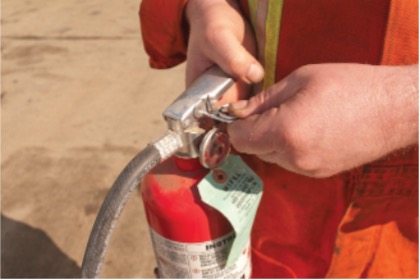
Pull
Pull the pin from the handle, breaking the plastic seal.
Aim
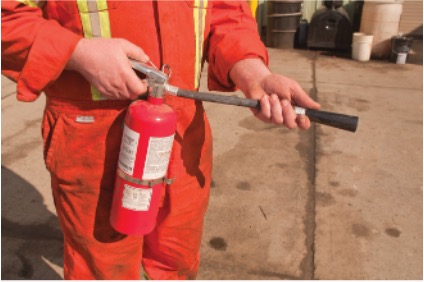
Aim the extinguisher nozzle at the base of the flames. This is where the burning material is located. If you aim at the flames, which is frequently the temptation, the extinguishing agent will fly right through and be ineffective. You want to hit the fuel source.
Squeeze and Sweep
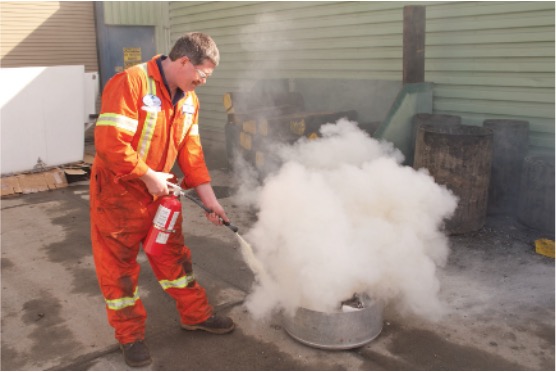
Keep the extinguisher upright and squeeze the handles together to discharge the pressurized extinguishing agent.
Sweep the extinguisher nozzle from side to side, covering the fire completely with extinguishing agent. Start using the extinguisher from a safe distance and move forward carefully—watch for scattering material. The idea is to completely cover the fuel. Keep spraying until the fire is out and monitor the area in case it reignites.
 Self-Test A-5.4: Describe First-Response Firefighting
Complete Self-Test A-5.4 and check your answers.
If you are using a printed copy, please find Self-Test A-5.4 and Answer Key at the end of this section. If you prefer, you can scan the QR code with your digital device to go directly to the interactive Self-Test.
References
BC Industry Training Authority. (2019). Piping trades apprenticeship program: Perform safety related functions—Level 1 harmonized [Binder]. Crown Publications, Queen’s Printer for British Columbia. https://www.crownpub.bc.ca/Product/Details/7960000260_S
Camosun College. (2015). Line A: Safe work practices — Competency A-5: Describe Fire Safety. BCcampus. https://collection.bccampus.ca/textbook/VPwUd4rq/
Camosun College. (2015). Trades access common core competency A-5: Describe Fire Safety. Victoria, B.C.: Crown Publications. Download for free from the B.C. Open Textbook Collection (https://open.bccampus.ca/browse-ourcollection/find-open-textbooks/).
Media Attributions
All figures are sourced from Industry Training Authority (2019) and/or Camosun College (2019) and are used under the Creative Commons Attribution 4.0 (CC BY 4.0) licence unless otherwise noted. Images copyrighted by the BC Industry Training Authority are licensed under a Creative Commons Attribution-NonCommercial-ShareAlike 4.0 (CC BY-NC-SA 4.0) licence.
Putting out a small fire right away before it grows bigger. (Section A-5.4)
A system in a building that sprays water automatically when it detects heat from a fire. (Section A-5.4)
A small device you can carry that sprays chemicals or water to put out a fire. (Section A-5.4)
Air that is dangerous to breathe because it contains smoke, chemicals, or toxic gases. (Section A-5.4)
A safe way to exit a building during an emergency
tools used to control or put out fires. (Section A-5.4)
Breathing in harmful smoke or gases. (Section A-5.4)
Safety gear such as gloves, goggles, or boots worn to protect the body. (Section A-1.4; Section A-4.1)
A substance used to put out a fire. (Section A-5.1)
A very small fire that has just started. (Section A-5.4)
Containing air or gas that is tightly packed inside to push something out. (Section A-5.4)
The material that is burning in a fire. (Section A-5.4)
To start burning again after being put out (Section A-5.4)