A-3.4 Describe Information to be Disclosed on a Safety Data Sheet (SDS)
A safety data sheet (SDS) is a technical bulletin created by the producer of a hazardous product. An SDS provides specific hazard information, safe handling information, and emergency procedures for a single hazardous product. The SDS is a key part of the WHMIS program as it provides informational support to workers when working with or around a hazardous product.
Since the SDS contains detailed health and safety information specific to each hazardous product, it should be used as a key source of information for developing training programs and safe work procedures. Workers must be trained to understand the basic requirements of an SDS as well as the applicable information in it.
In addition to providing adequate education, employers are responsible for making SDSs available, accurate and up-to-date for all workers at all times. Employers must ensure that up-to-date SDSs are received for all hazardous products purchased. No SDS on site can be more than three years old unless the employer has written confirmation from the supplier that the SDS hasn’t changed.
If the employer produces a hazardous product for use at the workplace, the employer must develop an SDS for that product and make it available to workers. Copies of supplier and employer SDSs must be readily accessible to employees during each work shift.
SDS Sections

The following are the 16 section headings within an SDS and the types of information to be provided in each section.
Note: Example images are excerpts from an SDS for chromium (III) acetate hydroxide, from EHSADMIN on Wikimedia Commons (CC BY-SA 3.0). See Appendix A for the full SDS.
Note: Sections 12 to 15 require the headings to be present, but under Canadian regulations, the supplier has the option to not provide information in these sections.
Section 1: Identification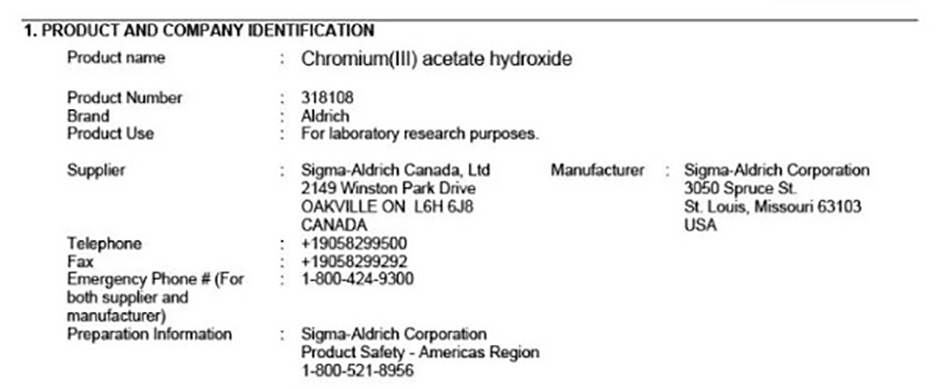
This section identifies the product, the manufacturer and the supplier, and it describes the intended product use. It also provides information about where to contact the manufacturer and supplier for information and/or in case of emergency.
Section 2: Hazard Identification
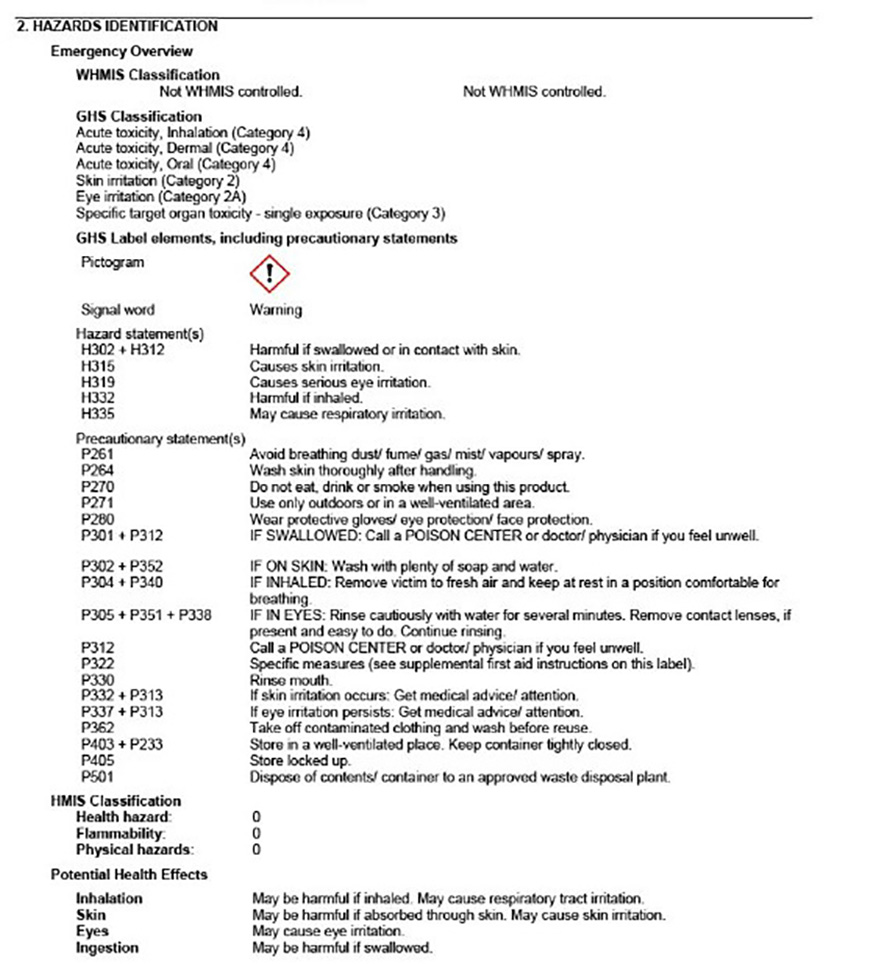 This section lists the classification of the hazardous product, hazard pictogram, signal word, hazard statement and precautionary statements for each category or subcategory applicable, as well as other hazards known to the supplier with respect to the product.
Section 3: Composition/Information on Ingredients
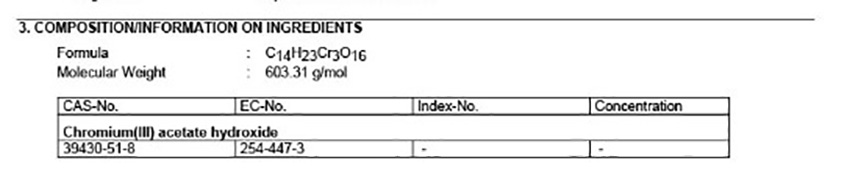 This section contains general information on physical and chemical properties such as the chemical name, common name and synonyms, CAS registry number, and any unique identifiers, mixture concentrations, or stabilizing additives.
Section 4: First-Aid Measures

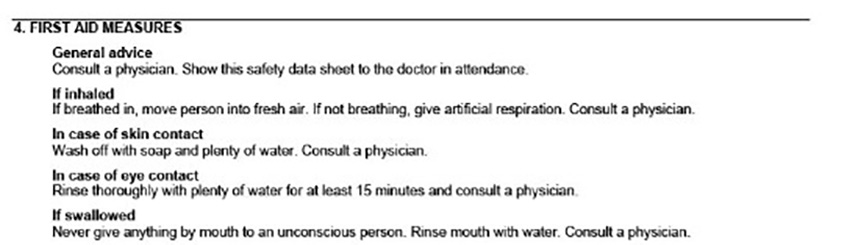 This section lists specific instructions for the immediate treatment of a worker who has inhaled or swallowed the product or who has had skin or eye contact with the product.
Section 5: Firefighting Measures
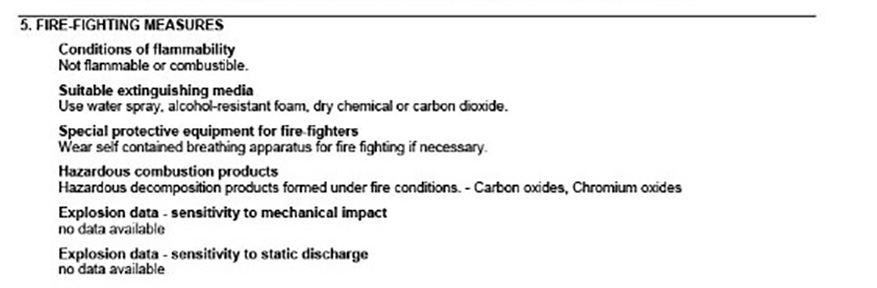 This section lists the information for developing strategies and procedures to deal with fire hazards.
Section 6: Accidental Release Measures

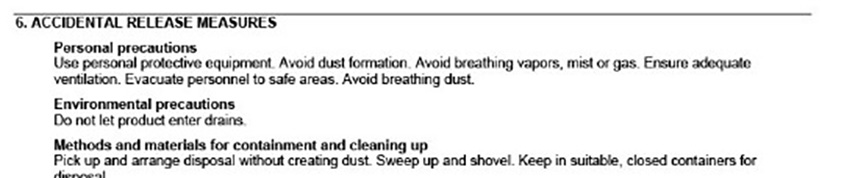 This section includes information on required protective equipment, as well as on how to safely clean up and contain spills.
Section 7: Handling and Storage
 This section includes information on how to safely handle and store the product.
Section 8: Exposure Controls/Personal Protection
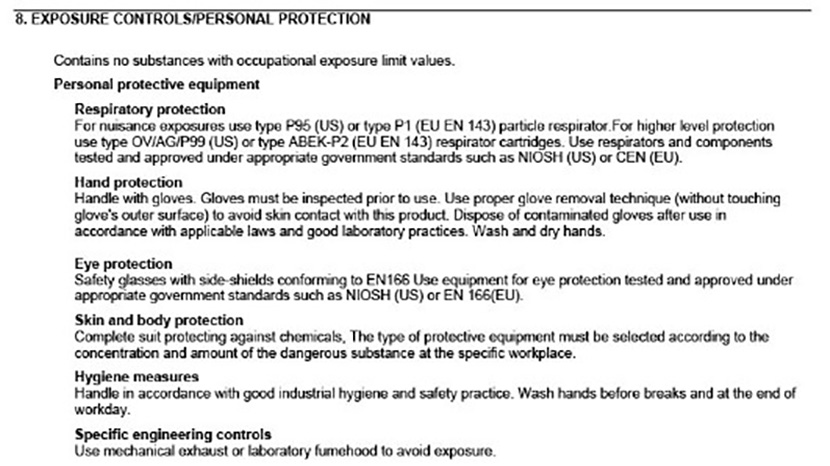 This section includes information on how to control exposure as well as exposure limit values.
Section 9: Physical and Chemical Properties

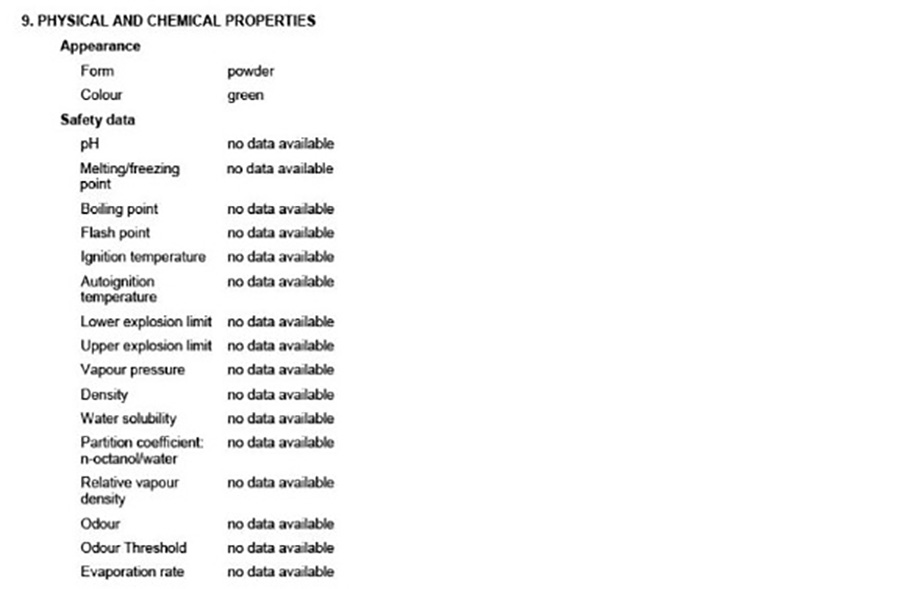 This section includes information on all of the physical and chemical properties of the hazardous product.
Section 10: Stability and Reactivity Data
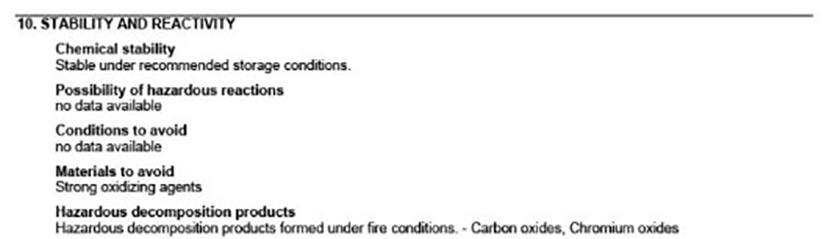 This section lists conditions and other substances that should be avoided to prevent dangerous reactions.
Section 11: Toxicological Information
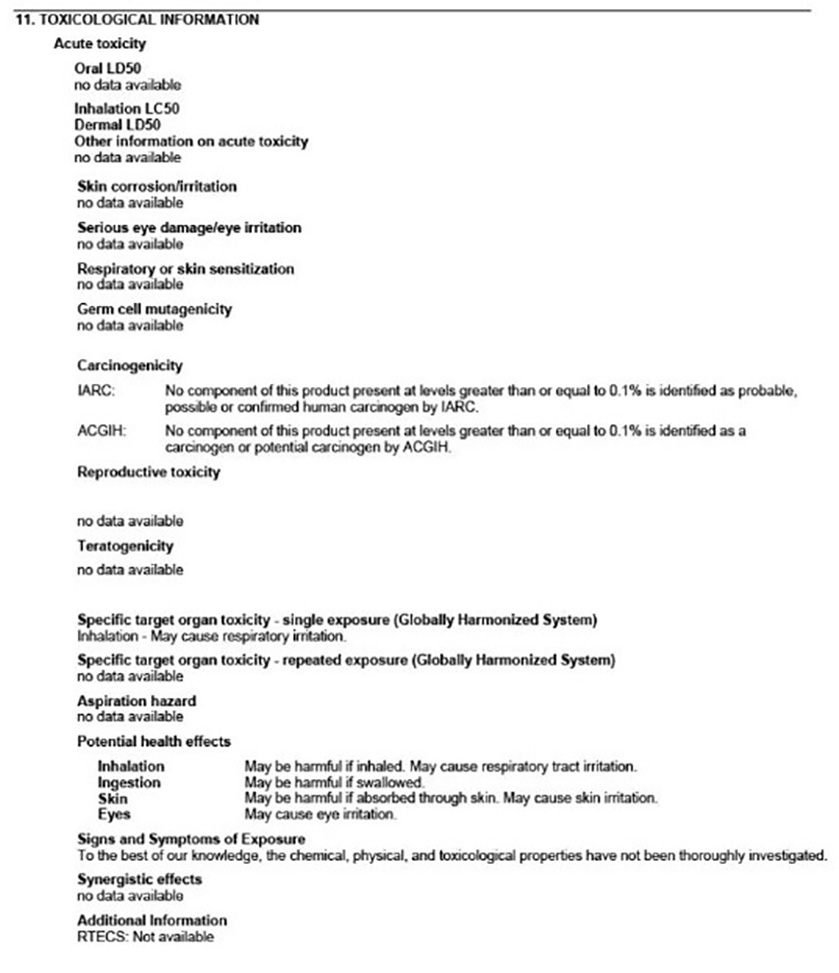 This section identifies how the substance enters the body and the possible health effects from single or repeated exposure. It also identifies if the product has any known long-term health effects such as liver or kidney damage, sensitization, cancer, or reproductive effects.
Section 12: Ecological Information
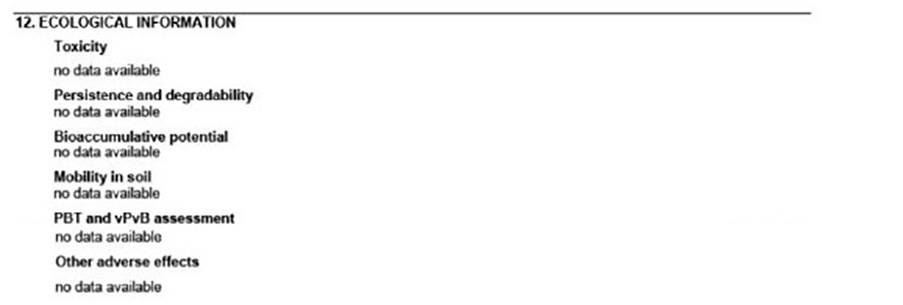 This section identifies what short- or long-term effects the substance could have on the environment.
Section 13: Disposal Considerations

 This section includes information on the safe handling and disposal methods, including any containment packaging required.
Section 14: Transport Information
 This section includes all of the necessary international shipping information.
Section 15: Regulatory Information
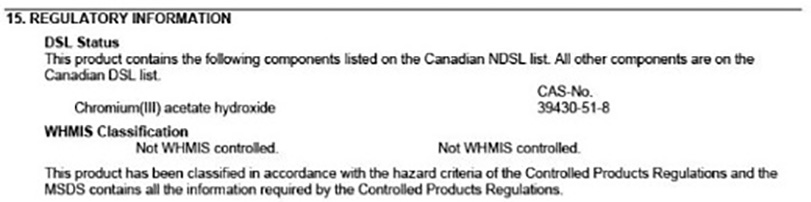 This section includes any safety, health and environmental regulations that have been made specific to this product.
Section 16: Other Information

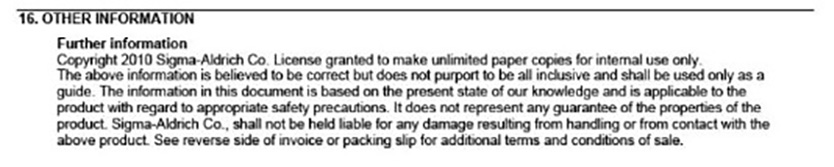 This section includes the date of the latest revision of the safety data sheet along with any other copyright information, legal disclaimer and additional terms or conditions for the sale of the product.
Appendix A shows the complete sample SDS for chromium acetate hydroxide.
 Self-Test A-3.4: Describe Information to be Disclosed on an SDS
Complete Self-Test A-3.4 and check your answers.
If you are using a printed copy, please find Self-Test A-3.4 and Answer Key at the end of this section. If you prefer, you can scan the QR code with your digital device to go directly to the interactive Self-Test.
References
BC Industry Training Authority. (2019). Piping trades apprenticeship program: Perform safety related functions—Level 1 harmonized [Binder]. Crown Publications, Queen’s Printer for British Columbia. https://www.crownpub.bc.ca/Product/Details/7960000260_S
Camosun College. (2015). Line A: Safe Work Practices — Competency A-3: Handle Hazardous Materials Safely (BCcampus). https://collection.bccampus.ca/textbook/PMfB6kHM/
Camosun College. (2015). Trades Access Common Core Competency A-3: Handle Hazardous Materials Safely. Victoria, B.C.: Crown Publications. Download for free from the B.C. Open Textbook Collection (https://open.bccampus.ca/browse-ourcollection/find-open-textbooks/).
Media Attributions
All figures are sourced from Industry Training Authority (2019) and/or Camosun College (2019) and are used under the Creative Commons Attribution 4.0 (CC BY 4.0) licence unless otherwise noted. Images copyrighted by the BC Industry Training Authority are licensed under a Creative Commons Attribution-NonCommercial-ShareAlike 4.0 (CC BY-NC-SA 4.0) licence.
- Taking notes is Designed by Freepik and is used under the Freepik Terms of Use.
- Hazard by Clker-Free-Vector-Images from Pixabay is used under the Pixabay Content License.
- First Aid by Clker-Free-Vector-Images from Pixabay is used under the Pixabay Content License.
- Protective equipment by David from Pixabay is used under the Pixabay Content License.
- Chemicals by Satheesh Sankaran from Pixabay is used under the Pixabay Content License.
- Disposal by OpenIcons from Pixabay is used under the Pixabay Content License.
- More information by mcmurryjulie from Pixabay is used under the Pixabay Content License.
- “Cr-Ac-OH-MSDS SigmaAldrich.pdf” by EHSADMIN from Wikimedia Commons is used under a CC BY-SA 3.0 license. Also see Appendix A for the full SDS in PDF format.