A-1.2 Describe Short-Term Hazards in the Trades
A short-term hazard can be described as any hazard that may cause injury and/or illness and that may be remedied in a short period of time. This section will discuss some of the short-term hazards likely to be encountered when working in the trades.
Slips, Trips, and Falls
Slips, trips, and falls on walking and working surfaces are the cause of many injuries in the workplace. Some of these accidents are the result of environmental conditions and others happen because of poor housekeeping and careless behaviour. You can best avoid slips, trips, and falls by being aware of your surroundings and following some general walking- and work-surface guidelines:
- Keep all walking and working areas clean and dry.
- Keep all walking and working surfaces clear of clutter and debris.
- Install cables, extension cords, and hoses so that they will not become tripping hazards.
- Do not run on any work surface.
- If footing is unstable, use short steps with feet splayed out.
Excavations
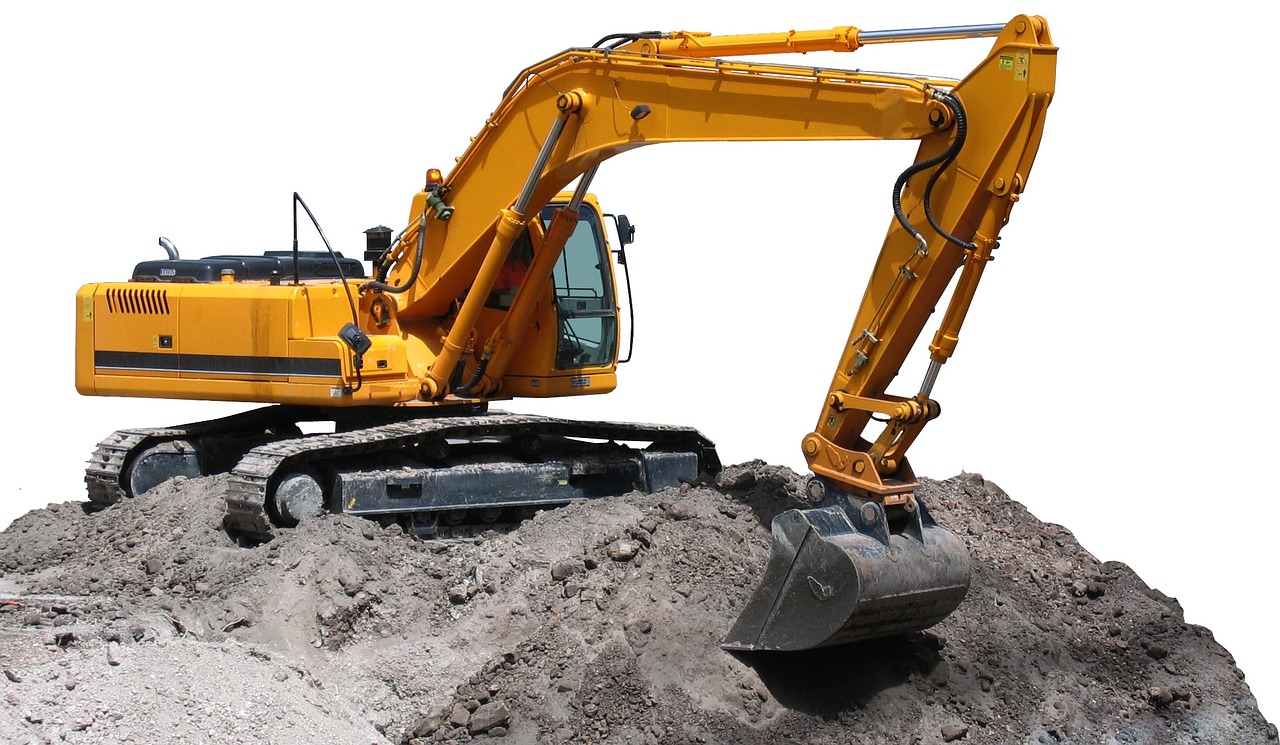
An excavation is the removal of ground material by digging in order to bury or access pipelines, conduits, foundations, etc. Trenches are special types of excavations in which the depth exceeds the width. Sometimes the terms excavation and trench are used interchangeably, but there is a difference. Because trenches are narrow, workers can easily become trapped.
Hazards involved with trench and excavation work include:
- Cave-ins and crushing
- Water accumulation
- Falling objects
- Collapse of adjacent structures
- Toxic gases in the soil
Cave-ins are the most common and deadliest hazard in excavation work. When dirt is removed from an excavation, the surrounding ground can become unstable, and gravity may cause it to collapse. If a trench is deeper than 1.2 metres (4 ft), you must be protected from cave-ins by either trench shoring or sloping. It is essential you understand and follow the appropriate shoring and sloping requirements before entering or working in or around an excavation.
Shoring
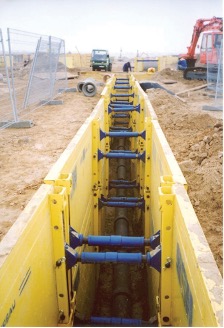
Several methods can be used to shore up a trench. Hydraulic shoring uses hydraulic pistons that are extended outward until they press prefabricated plates against the trench walls, as shown in Figure 1.
Timber and plank shoring is used if the trench is too wide or too irregular for prefabricated shoring, as shown in Figure 2.
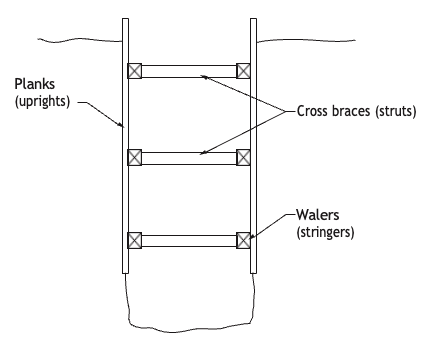
The size and spacing of the parts of a timber and plank system are given in the WorkSafeBC OHS Regulation. Size and spacing vary depending upon the type of soil that the trench is dug into and the depth of the trench.
Planks may be spaced if the soil is stable, but must be close fitting if the soil is loose and free running. Plywood sheathing is sometimes used in place of planks.
Timber shoring is slow to install because it must be installed from the top down. It is unsafe for a worker to enter the trench before it is shored.
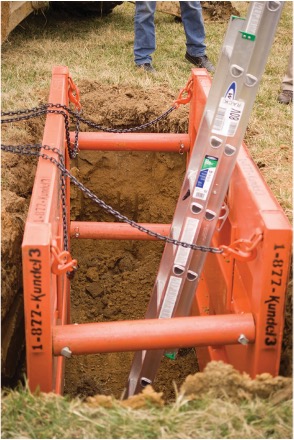
Trench shields or trench boxes are prefabricated structures (Figure 3). These are not adjustable within the trench and are designed to protect the workers, should a collapse occur, whereas shoring is designed to prevent the walls from collapsing.
Sloping
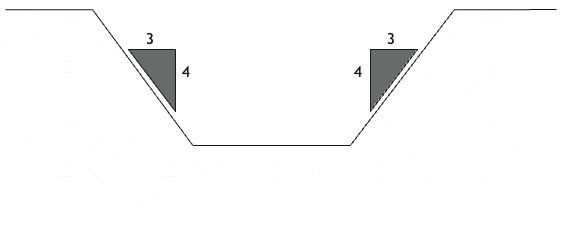
Sloping a trench creates a naturally stable slope, similar to that which loose excavated material forms when dumped on a level surface, known as the angle of repose. Unshored trench and excavation walls must be sloped flatter than the angle of repose, but in no case steeper than 3 horizontal to 4 vertical units unless otherwise specified in writing by a professional engineer (Figure 4).
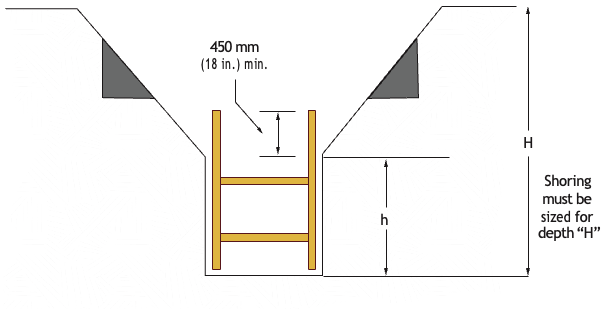
As demonstrated in Figure 5, sometimes a combination of sloping and shoring is used.
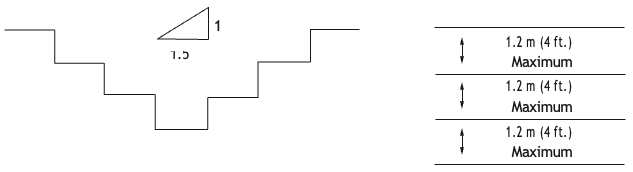
Another method of sloping is called benching. All benched excavations 6.1 m (20 ft.) or less in depth shall have a maximum rise between benches of 1.2 m (4 ft.). For unrestricted worker access at any level, the width of the bench immediately above any particular rise shall not be less than 1.5 times the height of that rise. For example, in Figure 6 the minimum bench width for a 1.2 m (4 ft.) rise would be 1.8 m (6 ft.).
Keep all piles of material and equipment at least two feet away from the edge of an excavation.
Loose rock, soil, materials and equipment on the face or near the excavation can fall or roll into the excavation, or overload and possibly collapse the excavation walls. When working in a trench, provide a safe means of access and egress for workers, such as a ladder, stairway, or ramp. Long trenches require multiple exit points.
Working Around Vehicles and Heavy Equipment
Workers are often required to work near vehicles and mobile equipment. It is the workers’ responsibility to keep out of the way. When working near moving vehicles and equipment, workers should:
- Stay alert at all times and keep a safe distance.
- Stay out of the circle formed by the extended bucket of an excavator (swing).
- Never get into blind spots of operators.
- Maintain eye contact with the operator.
- Never stand under loads handled by lifting or digging equipment, or near vehicles being loaded or unloaded.
- Wear reflective or high-visibility vests, hard hats, steel-toed boots, and appropriate hearing protection while working near equipment.
- Alert the operator of any impending hazards, electrical wires, gas lines, sewer or water lines, etc.
Elevated Work

Working in elevated situations can be very dangerous. Falls from elevated areas are one of the leading causes of fatalities among workers. While the risk of falls is high, there is much you can do to protect yourself. Using the appropriate personal protective equipment (PPE), practising good housekeeping habits, and staying alert at all times will help you stay safe when working at elevations. In later sections, we will cover the OHS Regulation related to scaffolding and fall protection; it is important that you make yourself aware of this before proceeding to work at elevations.
Confined Spaces
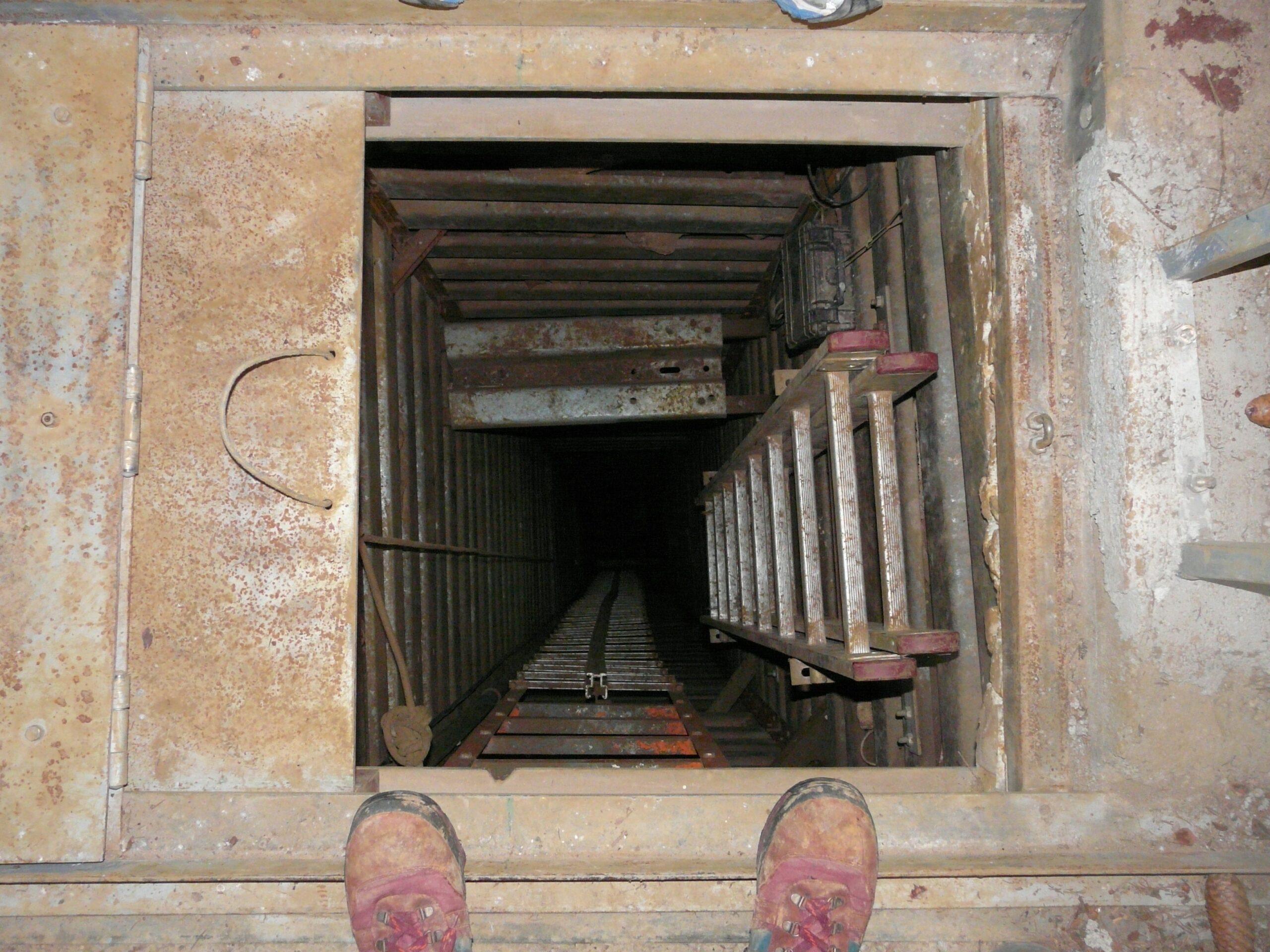
A work area that is not meant for human habitation, with limited access and egress (a way to exit) where there is a potential risk, is known as a confined space. A confined space can be any enclosed space where there is a risk of death or serious injury from hazardous substances or dangerous conditions (e.g., lack of oxygen). You must understand the hazards and safety precautions for working in confined spaces.
Some examples of confined spaces that are fairly easy to identify include:
- Storage tanks, silos, vessels and vats
- Manholes, sewers and ductwork
- Combustion chambers in furnaces, etc.
- Unventilated or poorly ventilated rooms
Some places must be assessed at their location as confined spaces. It is not possible to provide a comprehensive detailed list of confined spaces, though many of the dangers associated with confined spaces are listed below:
- A lack of oxygen can occur due to a process or reaction.
- Poisonous gas, fumes or vapour can build up in sewers and manholes or enter tanks and vessels from connecting pipes.
- Liquids and solids can suddenly fill the space.
- Free-flowing solids such as grain can form a solid section and then suddenly collapse.
- Flammable vapours or residues left in tanks or vessels can explode or catch fire.
- Dust may be present in high concentrations in flour or grain silos.
- Hot conditions can lead to a dangerous increase in body temperature.
Video and Safety Materials: Confined Spaces
- Review the WorkSafeBC website for the most current information: Hazards of Confined Spaces
- Refer to the Occupational Health & Safety Regulation, Part 9.1 [online]: Confined Spaces Definitions
- Watch the video, Confined Spaces: Safe Yesterday, Deadly Today [3.25] by WorkSafeBC (2008) on YouTube.
If you are using a printed copy, you can scan the QR code with your digital device to go directly to the video: Confined Spaces: Safe Yesterday, Deadly Today

Electrical Hazards
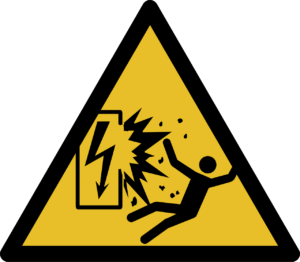
 No matter what your trade, many jobs will require you to use or work around electrical equipment. Extension cords, power tools, and portable lights are among the many pieces of equipment that use electricity.
There are different types of electrical accidents, including:
- Burns
- Electric shock
- Explosions
- Falls caused by electric shock
- Fires
While the human body is a conductor of electricity, it is not a good one. Burns caused by electric shock are a result of the heat caused by resistance to electrical current. Electrical burns often occur below the skin surface and can damage muscle and nerve tissue. In severe cases, electrical burns can be fatal.
The extent of injury due to electric shock depends on a combination of voltage and current and the body’s resistance to the electricity passing through it—a condition that changes from person to person. An electric shock occurs when you become part of the electrical circuit; that is you contact a live portion of a circuit while in also in contact with a lower potential such as ground.
Even though you may normally deal with small voltages and current, the values are never far away from lethal levels. You can receive a shock or burn from any common electrical circuit. The severity of the electrical shock depends on a number of factors:
- The amount of current that passes through the body
- The path that the current takes through the body
- Type of voltage—AC or DC
- Voltage strength
- The length of time that the current flows within the body
- Condition of the skin and the body’s chemical make-up
- Area of contact
Normal household current (plugs and light circuits) is generally limited by a circuit breaker to a value of 15 amperes. This device has been designed to trip and open a circuit if the 15-ampere value is exceeded and is designed to protect against property damage. It is possible to cause a fatal injury with a current flow of only 50 milliamperes (mA) or 5 one-hundredths of an ampere. The body is sensitive to relatively small values of current. In comparison, a 100-watt light bulb draws approximately 0.85 amperes (850 mA) of current when connected to a 120-volt source. Remember, we have 15 amperes available in each standard house circuit. Industrial circuits may have a required flow of several hundred amperes. In both cases, these are dangerous amounts!
Most fatal shocks occur when current passes through or near the heart. This is possible if the circuit passes from one arm to the other, from the right arm to the left leg, or from the left arm to the right leg. Figure 7 lists the effects of increasing amounts of current on the human body.
|
Amount of Current |
Effect |
|
1 mA or less |
No noticeable feeling experienced. |
|
1–3 mA |
Shock is just felt. |
|
3–10 mA |
Shock is painful. Individual can still use motor functions. Muscular control is not lost. |
|
10–20 mA |
Some individuals will experience a loss of voluntary muscular control. |
|
20–50 mA |
Individual cannot let go of the circuit. Breathing may become difficult. |
|
50–200 mA |
Ventricular fibrillation of the heart may occur, causing death. Severe muscular contraction and nerve damage are possible. |
|
Over 200 mA |
Heart paralysis may occur. Severe burns are possible. |
Rescuing Shock Victims: First Aid for Electrical Shock Victims
Consult your employer’s first aid attendant or medical personnel on acceptable procedures for dealing with local electrical shock emergencies. The most important things to know about assisting an electrical shock victim are listed below:
- Do not touch a victim who is still connected to the power source. If you touch a victim who is in contact with an electrical source, you will become part of the circuit too, resulting in another casualty.
- Safely remove the power from the victim.
- If you cannot de-energize the circuit, separate the victim from the live circuit by using a piece of non-conductive material such as a stick of lumber or wooden handle.
- If the shock victim is unconscious and has stopped breathing, start artificial respiration at once. Do not stop until a medical authority instructs you to stop.
Lockout and Tagout (LOTO)
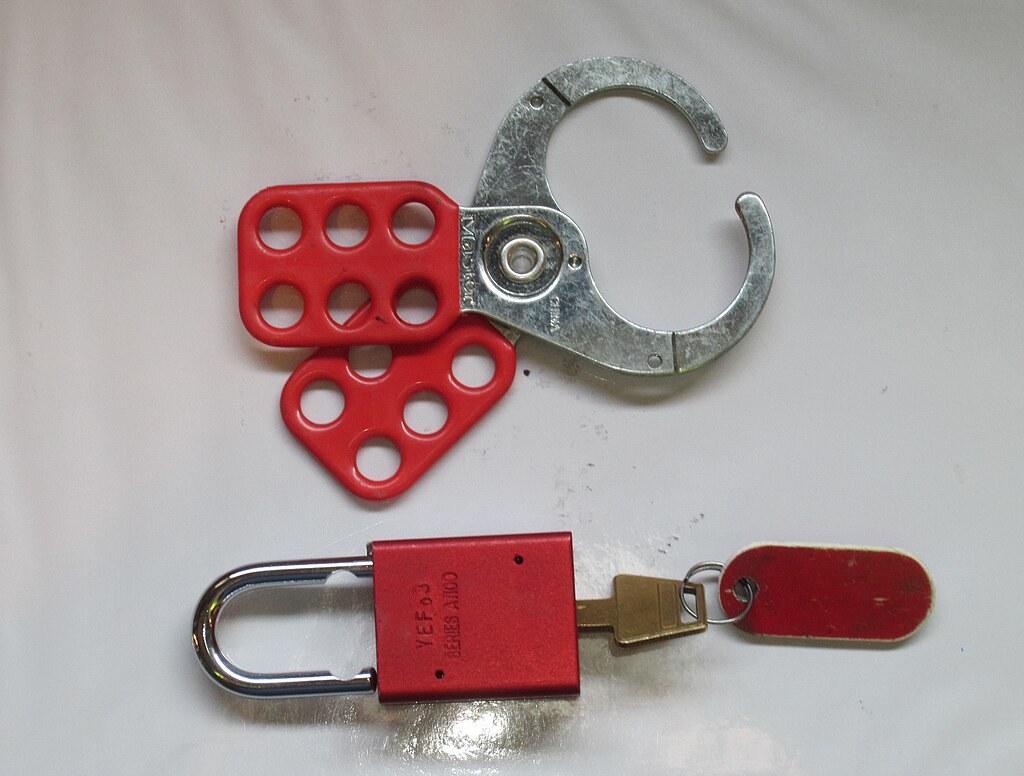
A lockout or tagout system (LOTO) is designed to protect workers from hazardous energy while they work with machines or equipment. As the name implies, a lockout procedure systematically uses locking devices to completely secure equipment that controls or represent a hazard. It also ensures that equipment is de-energized before being maintained or repaired.
Energy sources can include:
- Hydraulic or pneumatic energy
- Mechanical and kinetic energy
- Gravitational and potential energy
- Electrical energy
The following assumptions are unacceptable where safety is concerned:
- It is not enough to simply throw a switch and start work.
- It is not enough to hang a “do not use” sign on a machine.
- It is not enough to tell everyone not to turn on the power.
- It is not enough to have everyone assure you that no one will activate the power.

Specific lockout procedures will be covered in Section A-1.7.
Compressed Gas
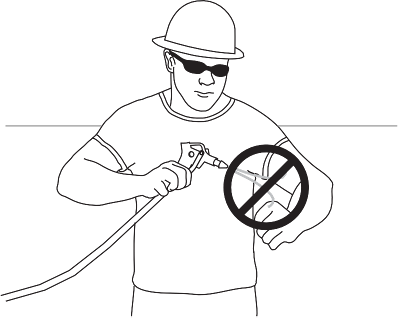
 Compressed air is used in shops and on-site for operating nailers, staplers, impact tools, equipment, and paint sprayers. However, cleaning objects, machinery, bench tops, clothing, and other items with compressed air is dangerous. Injuries can be caused by the air jet and by particles made airborne. If compressed air must be used to clean equipment, the nozzle pressure must remain below 10 psi (69 or 70 kPa) and personal protective equipment (PPE) must be worn to protect the worker’s body, especially the eyes, against particles and dust under pressure.
Compressed gases are often supplied to the job site in pressurized cylinders. Extreme caution should be used when working with these cylinders, as a damaged cylinder is an explosion hazard. A screw-on protective cap protects the cylinder valve. The cylinders and protective caps are usually black, although green and other colours are also used. The caps have right-hand threads (like all oxygen fittings) and come in various sizes to match the cylinders.
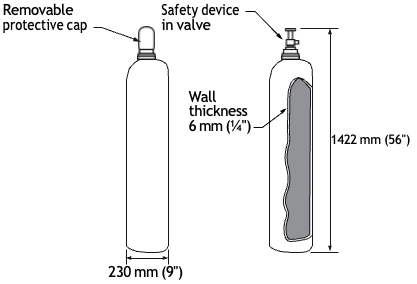
The following safety procedures must be observed:
- Do not accept or use any compressed gas cylinder that does not have proper identification of contents.
- Always treat cylinders as if they are full, and handle accordingly.
- Never drop cylinders or let them strike each other violently.
- Protect cylinders and any related piping and fittings against damage.
- Do not use slings or magnets for hoisting cylinders.
- Transport cylinders securely on a hand truck whenever possible. NEVER drag them.
- Secure transported cylinders to a suitable cradle or platform to prevent movement or upset.
- Chalk “EMPTY” or “MT” on cylinders that are empty. Close valves and replace protective caps.
- For detailed handling procedures, consult the manufacturer, the supplier and the MSDS.
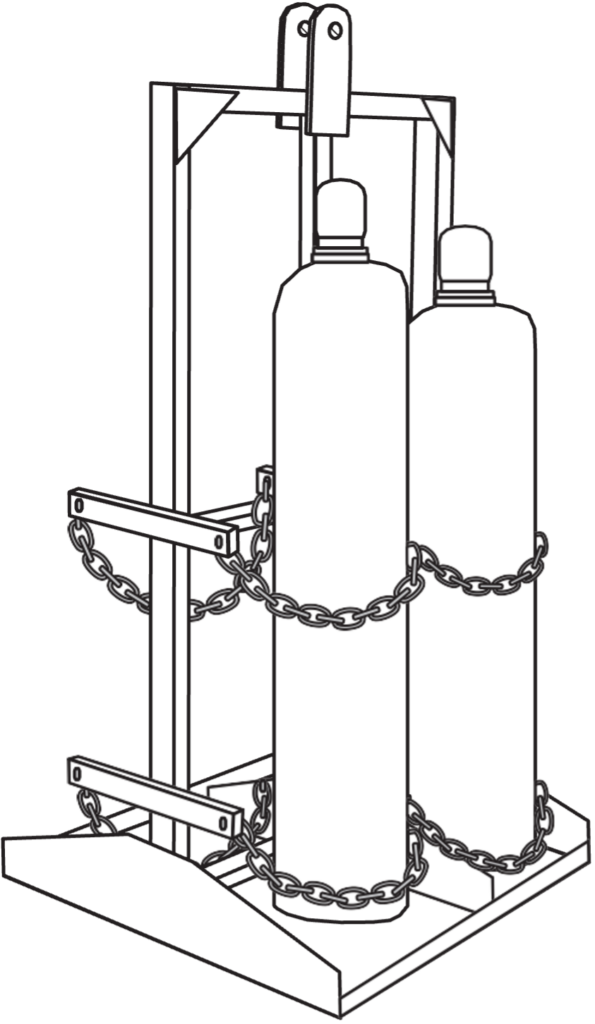
Storing Cylinders
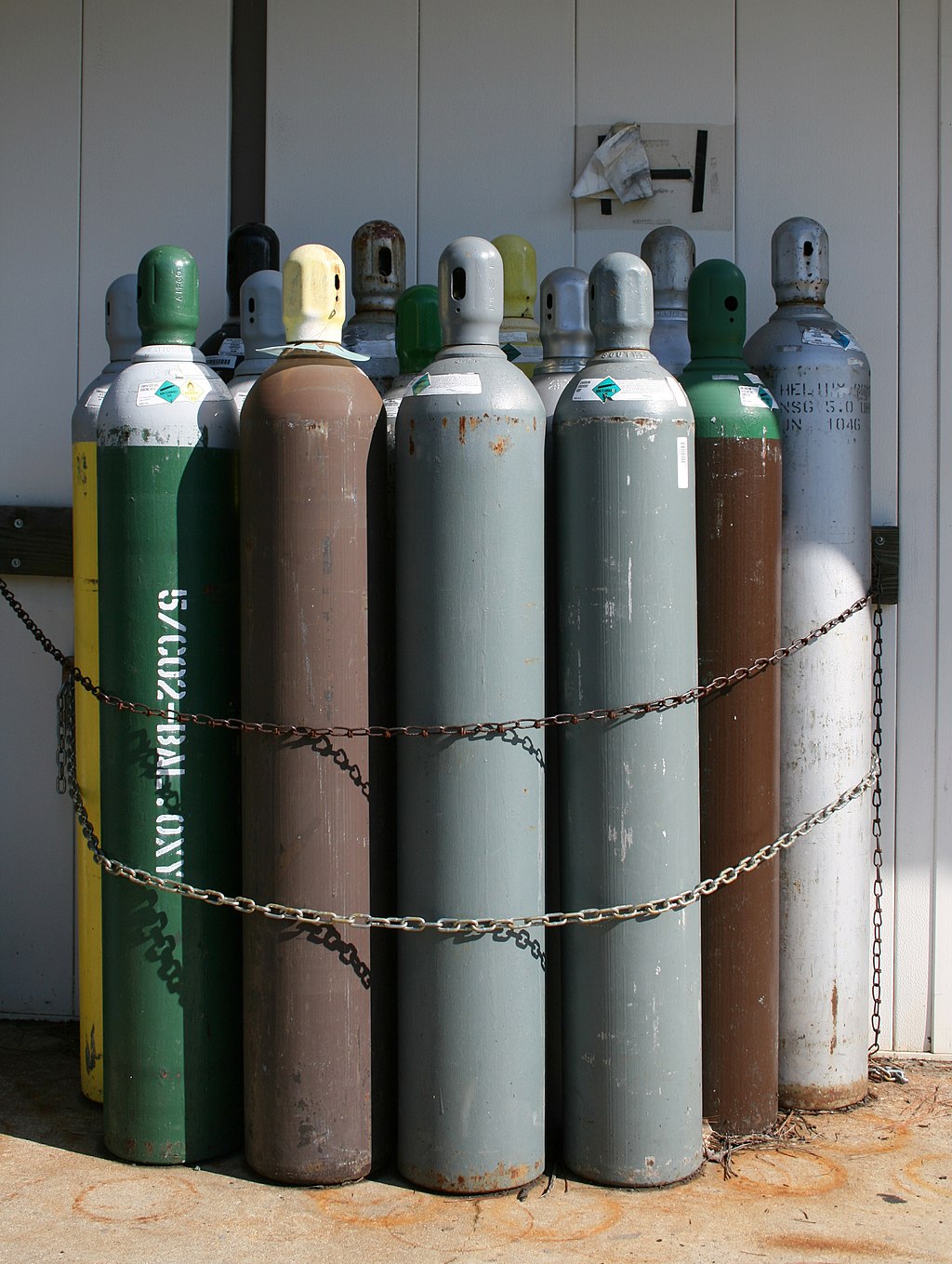
These safety measures must be observed when storing gas cylinders:
- Store cylinders upright in a safe, dry, well-ventilated location that is maintained specifically for this purpose.
- Never store different flammable and combustible materials such as oil and gasoline in the same area.
- Do not store cylinders near elevators, walkways, stairwells or exits, or in places where they could be damaged or knocked over.
- Do not store oxygen cylinders within 6 m (20 ft.) of cylinders containing flammable gases unless they are separated by a partition at least 1.5 m (5 ft.) high that has a fire- resistance rating of at least 30 minutes.
- Store empty and full cylinders separately.
- Prohibit smoking in the storage area.
Weather
Many jobs require that you work outside. Since work often continues during periods of hot, cold, and wet weather, you need to understand the hazards associated with weather and be properly prepared.
Cold Weather
When working outdoors during winter, workers need to protect themselves against loss of body heat. When your body temperature drops even a few degrees below normal, you can begin to shiver uncontrollably and become weak, drowsy, disoriented, unconscious, or even fatally ill.
Hypothermia is the condition in which your body loses heat at a rate greater than you are able to produce it.
Cold temperatures, wind, poorly insulated or wet clothing, immersion in water, and fatigue are some of the main factors that contribute to hypothermia.
The following guidelines can help you keep your body warm and avoid hypothermia, frostbite, and overexposure to the cold:
- Properly insulated headgear, footwear, and gloves are important. Heat loss is greatest from the head. Dress in layers.
- Wind causes cooling or “wind chill.” The stronger the wind at a given temperature, the cooler the wind chill will be.
- Water chills your body far more rapidly than air or wind. When working outdoors, always have proper waterproof clothing and extra dry clothes available.
- Even on a very cold day, strenuous activities can cause you to perspire. When you slow down to a normal pace, this moisture will add to the chilling effect.
- Cold-water immersion speeds up the process of cooling down the body. When you’re in the water, heat is conducted away from the body 25 times faster than in cold air. Severe hypothermia can develop rapidly if you are immersed in cold water without the protection of survival gear.
Hypothermia Danger Signs
The effects of hypothermia can be gradual and often go unnoticed until it’s too late. Early intervention is very important. Work with a buddy. Always stay on the lookout for early signs of hypothermia in both yourself and your buddy.
Classic signs of hypothermia are known as the “umbles”: a worker mumbles, fumbles and stumbles. Other additional signs of hypothermia are:
- A drop in body temperature.
- Fatigue or drowsiness.
- Uncontrollable shivering.
Heat Stress
Heat stress occurs when abnormally hot air, humidity or extremely heavy exertion prevents your body from cooling itself fast enough.
Avoid heat stress through the following preventive measures:
- Drink plenty of water and avoid very cold water.
- Avoid alcoholic or caffeinated drinks; coffee and tea are diuretics.
- Do not overexert yourself.
- Wear lightweight, light-coloured clothing of natural material.
- Keep your head covered and face shaded.
- Wear loose-fitting clothing, so long as it doesn’t create a hazard.
- Take frequent short breaks.
- Rest in the shade whenever possible.
Heat Exhaustion
Heat exhaustion usually occurs when people exercise heavily or work in warm, humid places where bodily fluids are lost through heavy sweating. When humidity is high, your sweat does not evaporate fast enough to cool your body.
Symptoms of heat exhaustion may include:
- Fatigue
- Irritability
- Headache
- Faintness
- Weak, rapid pulse
- Shallow breathing
- Cold, clammy skin
- Profuse perspiration
Treatment for heat exhaustion is as follows:
- Ask the person to lie down in a cool, shaded area or air-conditioned room.
- Elevate the feet. Massage the legs toward the heart. Give cold salt water ([latex]\frac{1}{2}[/latex] teaspoon to [latex]\frac{1}{2}[/latex] a glass of water) or a cool sweetened drink every 15 minutes until the victim recovers. Do not let the victim sit up, even after they feel recovered.
Heat Stroke
Heat exhaustion is often misinterpreted as heat stroke. Symptoms of heat stroke may include:
- Extremely high body temperature (106°F or higher)
- Hot, red, dry skin
- Absence of sweating
- Rapid pulse
- Convulsions
- Unconsciousness
Treatment for heat stroke is as follows:
- Remove the victim from the heat.
- Have the victim lie down.
- Move all nearby objects, as heat stroke may cause convulsions or seizures.
- Lower the victim’s body temperature quickly. This can be done by fanning; spraying with a cool mist; wrapping the victim in cold, wet sheets; or wiping with a wet cloth until the body temperature is reduced. Do not give stimulating beverages such as coffee, tea or soda. If available, a partially filled tub of cool water works best.
 Self-Test A-1.2: Describe Short-Term Hazards in the Trades
Complete Self-Test A-1.2 and check your answers.
If you are using a printed copy, please find Self-Test A-1.2 and Answer Key at the end of this section. If you prefer, you can scan the QR code with your digital device to go directly to the interactive Self-Test.
References
BC Industry Training Authority. (2019). Piping trades apprenticeship program: Perform safety related functions—Level 1 harmonized [Binder]. Crown Publications, Queen’s Printer for British Columbia. https://www.crownpub.bc.ca/Product/Details/7960000260_S
Camosun College. (2019). Line A: Safe work practices—Competency A-1: Control workplace hazards (Rev. ed.) [Learning guide]. BCcampus. https://collection.bccampus.ca/textbook/tQtm8KNK/
Camosun College. (2015). Trades Access Common Core Competency A-1: Control Workplace Hazards. Victoria, B.C.: Crown Publications. Download for free from the B.C. Open Textbook Collection (https://open.bccampus.ca/browse-ourcollection/find-open-textbooks/).
WorkSafeBC. (n.d.). Occupational health and safety regulation. WorkSafeBC. https://www.worksafebc.com/en/law-policy/occupational-health-safety/searchable-ohs-regulation/ohs-regulation
WorkSafeBC. (n.d.). Occupational health and safety regulation: Part 9: Confined spaces. https://www.worksafebc.com/en/law-policy/occupational-health-safety/searchable-ohs-regulation/ohs-regulation/part-09-confined-spaces
WorkSafeBC. (2008, September 9). Confined spaces: Safe yesterday, deadly today [Video]. YouTube. https://www.youtube.com/watch?v=rUM7tnYcOjQ
WorkSafeBC. (2013). Hazards of confined spaces [PDF]. WorkSafeBC. https://www.worksafebc.com/resources/health-safety/books-guides/hazards-of-confined-spaces
Media Attributions
All figures are sourced from Industry Training Authority (2019) and/or Camosun College (2019) and are used under the Creative Commons Attribution 4.0 (CC BY 4.0) licence unless otherwise noted. Images copyrighted by the BC Industry Training Authority are licensed under a Creative Commons Attribution-NonCommercial-ShareAlike 4.0 (CC BY-NC-SA 4.0) licence.
- Figure 1 Sbh s600 (Pre-fabricate hydraulic shoring) by Sbhrus, via Wikimedia Commons, is used under a
- CC BY SA 3.0 license.
- Figure 3 Trench box, by the National Institute for Occupational Safety and Health, via Wikimedia Commons, is in the public domain as a work of the U.S. federal government.
- Fall is by Clker-Free-Vector-Images from Pixabay and is used under the Pixabay Content License.
- Excavation by ronaldosantospires from Pixabay is used under the Pixabay Content License.
- Industrial Basket by Piotr Arnoldes from Pexels is used under the Pexels license.
- Confine space from pxhere is used under a CC0 Public Domain license.
- Arc-fault effects by Clemenspool from Wikimedia Commons, is used under a CC0 1.0 Universal Public Domain Dedication license.
- Lockout tongs by Wtshymanski from Wikimedia Commons, is used under a CC BY-SA 4.0 license.
- Danger Compressed Gas by Bigguy637 from Wikimedia Commons, is used under a CC0 1.0 Universal Public Domain Dedication license.
- Compressed gas bottles by Ildar Sagdejev (Specious) from Wikimedia Commons, is used under a CC BY-SA 4.0 license.
Any hazard that may cause injury and/or illness and that may be remedied in a short period of time. (Section A-1.2)
The removal of ground material by digging in order to bury or access pipelines, conduits, foundations, etc. (Section A-1.2)
Special types of excavations in which the depth exceeds the width. Sometimes the terms excavation and trench are used interchangeably, but there is a difference: trenches are narrow and workers can easily become trapped. (Section A-1.2)
A way to hold up the sides of a trench so they do not fall in. Strong supports, such as metal or wooden panels, are placed against the trench walls to keep workers safe while they work inside. (Section A-1.2)
A way to make a trench safer by cutting the sides at an angle instead of straight up and down. The sloped sides help stop the soil from collapsing into the trench. (Section A-1.2)
A way to keep a trench safe by using metal supports pushed into place with hydraulic pressure. These supports press against the trench walls to stop the soil from collapsing while workers are inside. (Section A-1.2)
A way to keep a trench safe by using wooden boards and supports to hold up the sides of the trench. The wood is placed against the trench walls to help stop the soil from collapsing while workers are inside. (Section A-1.2)
Prefabricated structures. These are not adjustable within the trench and are designed to protect the workers, should a collapse occur, whereas shoring is designed to prevent the walls from collapsing. (Figure 3, Section A-1.2)
The steepest angle that soil or sand can be piled without sliding or falling. In trenching and excavation work, knowing the angle of repose helps workers decide how much to slope the sides of a trench so the soil stays stable and does not collapse. (Section A-1.2)
A way to make a trench safer by cutting the sides into flat steps, like stairs. These steps help support the soil and reduce the chance of the trench walls collapsing while workers are inside. (Section A-1.2)
A safe way to get out of a place. It usually refers to doors, hallways, stairs, or exits that people use to leave a building quickly and safely, especially in an emergency. (Section A-1.2)
A work area, other than an underground working, that is not meant for human habitation, with limited access and egress (a way to exit), where there is a potential risk. Any enclosed space where there is a risk of death or serious injury from hazardous substances or dangerous conditions (e.g., lack of oxygen) is a confined space.
According to WorkSafeBC's (n.d.) Occupational health and safety regulation, an area, that:
(a) is enclosed or partially enclosed,
(b) is not designed or intended for continuous human occupancy,
(c) has limited or restricted means for entry or exit that may complicate the provision of first aid, evacuation, rescue or other emergency response service, and
(d) is large enough and so configured that a worker could enter to perform assigned work
A safety switch in an electrical system that automatically turns off the power if too much electricity flows through a circuit. This helps prevent wires from overheating and protects buildings and devices from electrical fires or damage. (Section A-1.2)
The condition in which your body loses heat at a rate greater than you are able to produce it. (Section A-1.1)