A-3.3 Describe the Labelling of Controlled Products
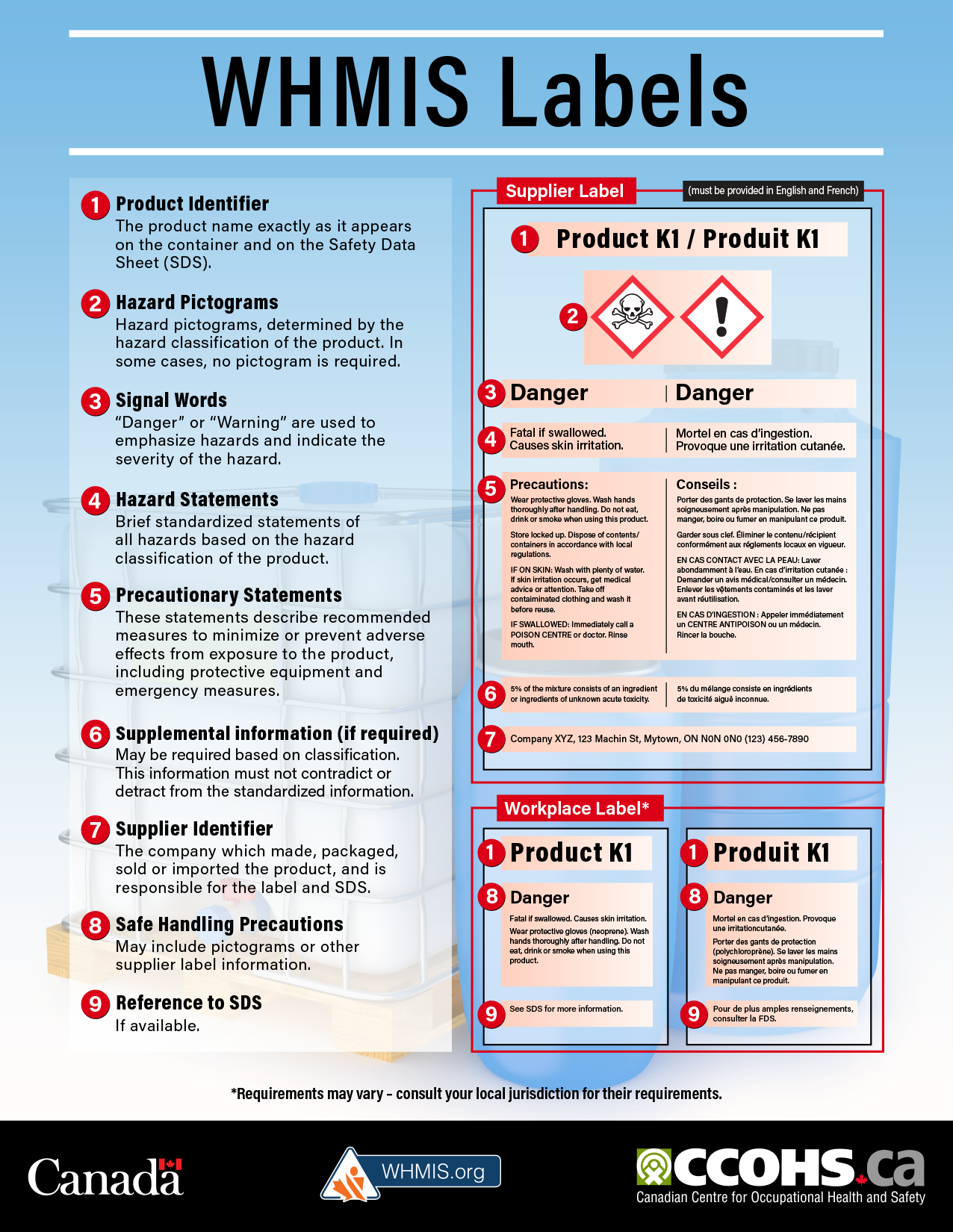
Two types of labels are required by WHMIS: supplier labels and workplace labels. In general, suppliers are responsible for providing supplier labels and employers are responsible for providing workplace labels or other means of on-site identification. Employers must also ensure that all labels at their workplace are legible and that they are replaced if damaged.
Supplier Labels
When a supplier produces or imports a product for distribution and sale in Canada, that supplier must prepare a supplier label. Seven items of information must be included within the label border:
- Product identification: Often the brand name, chemical name, trade name, common name, or generic name of the hazardous product.
- Initial supplier identifier: The name, address, and phone number of the supplier (manufacturer, distributor, or importer).
- Hazard pictogram(s): One or more of the nine graphic images indicating the type of hazard(s) the product presents.
- Signal words: “Danger” is used for high-risk hazards: “Warning” is used for less-severe hazards. If a signal word is assigned to a hazard class and category, only the one signal word corresponding to the class of the most severe hazard should be used on a label. Some hazard classes or categories do not have a signal word assigned to them.
- Hazard statement(s): Standardized phrases assigned to each hazard class and category that alert workers to the specific hazard(s) of the product. These are short statements, but they describe the most significant hazards of the product.
- Some examples of hazard statements are:
-
- Extremely flammable gas.
- Contains gas under pressure; may explode if heated.
- Fatal if inhaled.
- Causes eye irritation.
- May cause cancer.
- Precautionary statement(s): Standardized phrases that describe measures to be taken to minimize or prevent adverse effects resulting from exposure to the product or improper handling or storage. These statements can include instructions about storage, handling, first aid, personal protective equipment, and emergency measures.
- Examples of precautionary statements are:
-
- Keep container tightly closed.
- Wear protective gloves/protective clothing/eye protection/face protection.
- If exposed or concerned: Get medical advice/attention.
- Fight fire remotely due to the risk of explosion.
- Protect from sunlight.
- Supplemental label information: May include supplemental information about precautionary actions, physical state, or routes of exposure. Also, if the product is a mixture that contains any ingredients with unknown toxicity in amounts higher than 1 percent, the label must include a statement indicating the percentage of unknown ingredient.
See the example of a supplier label in Figure 1.
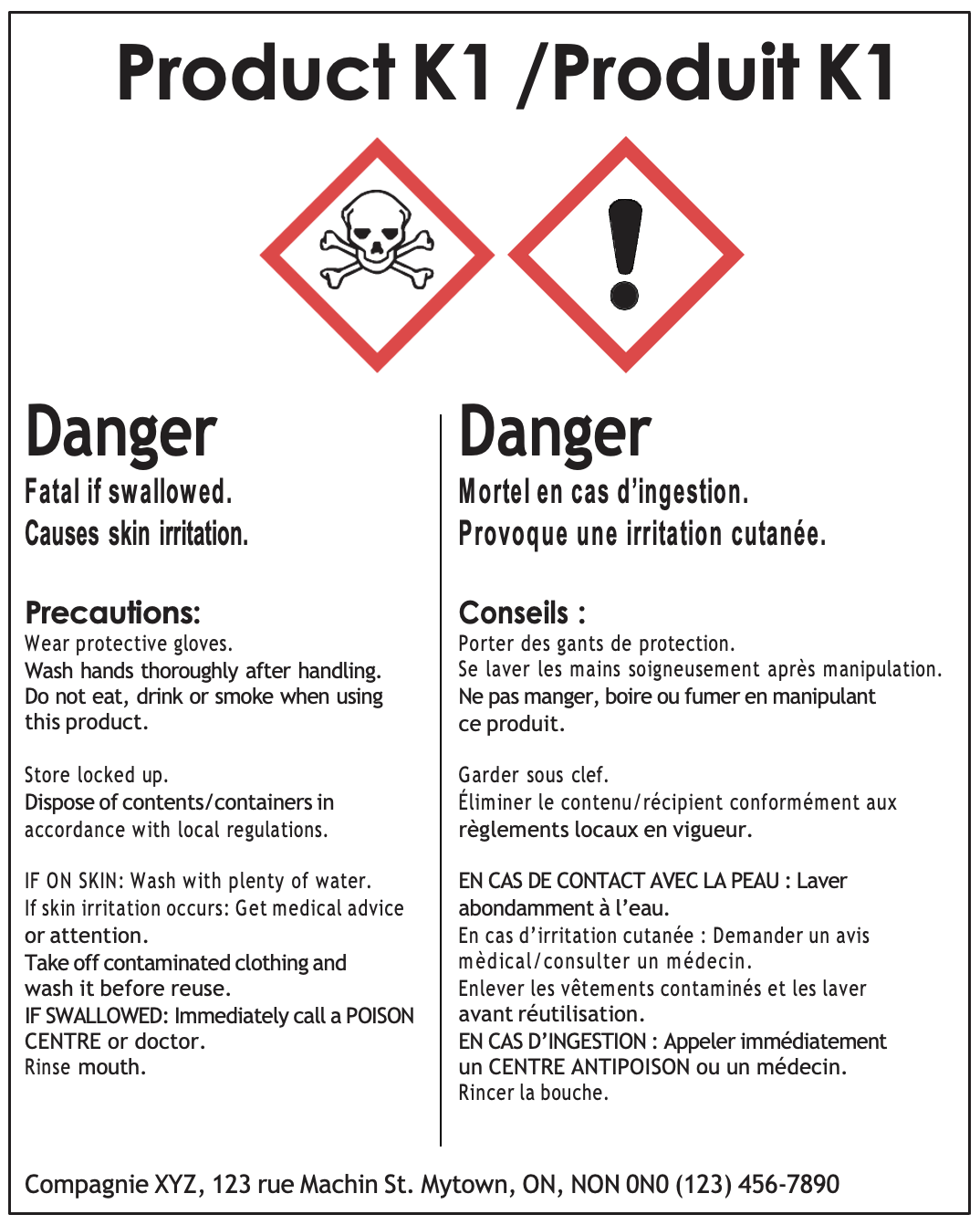
Additional requirements for supplier labels include:
- Only the above seven information items can be printed within the WHMIS label. Other information, such as directions for use, must be placed outside the WHMIS label.
- The written information must be shown in both English and French.
- The information must be correct and current. Labels need to be updated within 180 days of the supplier being aware of any significant new data. If an employer purchases a product within this 180-day time period, the supplier must inform the employer in writing, of the changes and the date they became available. Employers need to update the existing labels or the information on the containers as soon as the supplier provides the significant new information.
- Colours that conflict with transportation of dangerous goods (TDG) labelling cannot be used. For example, the colour orange cannot be used because it is used by TDG to identify explosives.
- The label must stand out from the container itself and other markings on the container. For example, the size of the label should be appropriate for the size of the container.
As long as a hazardous product remains in its supplier-provided container, the supplier label must remain attached to the container and must be legible.
Other Supplier Labels
Some supplier labels may look different from the example shown in Figure 1 because less information is required for controlled products that are:
- In small containers (less than 100 mL)
- Chemicals from laboratory chemical suppliers
- Laboratory samples
- Contained or transferred in a piping system, vessel, or tank
The Transportation of Dangerous Goods Act may require additional labels during transport. For multi-container shipments, a supplier label is not required on the outer container if a TDG label is present. Only the inner containers require supplier labels.
Workplace labels
Workplace labels are required on containers of hazardous products for any of the following situations:
- A hazardous product is produced and used on-site
- On secondary containers after a product has been transferred from the original container
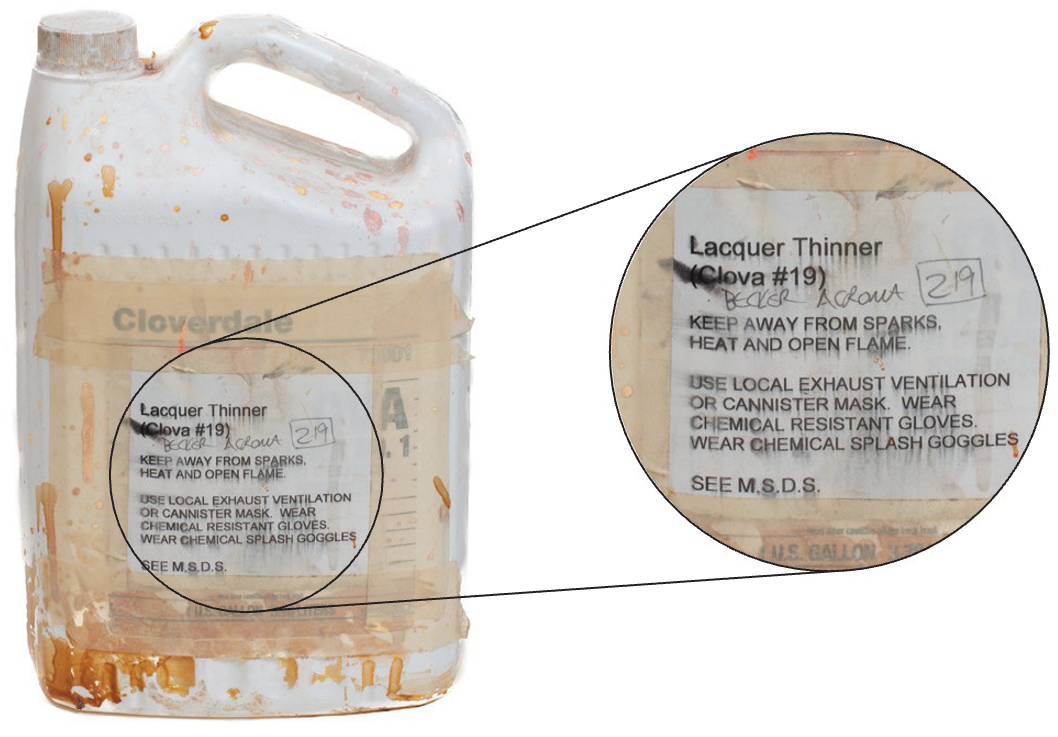
- On containers where the supplier label is missing or not readable.
Workplace labels provide three types of information:
- Product identifier
- Specific safe handling information and personal protective clothing and equipment required
- Reference to the SDS, if an SDS has been produced by the supplier
The format for workplace labels is fairly flexible. For example:
- The information can be written directly onto the container using a permanent marker.
- The languages used can be chosen to fit the specific workplace.
- The hazard pictograms are optional.
Figure 2 shows an example of a workplace label.
Other Means of Identification
In some circumstances where workplace labels are impractical, employers may use other means of identification such as warning signs, symbols, placards, and coding systems (for example, using colours, numbers or letters). These can be used as long as the identification system is communicated effectively and understood by workers.
These other means of identification can be used when the product is:
- Used in a laboratory (for example, in transfer containers such as beakers and flasks)
- Transferred by a worker into a container for use during the same shift if that worker maintains control of the new container and finishes use in that shift
- Contained in a transfer or reaction system such as a pipe, reaction vessel, tank car or conveyor belt
- Identified as a hazardous waste produced in the workplace
Partially Exempt Products
Products covered by other federal legislation are exempt from federal WHMIS requirements for supplier labels and SDSs. However, provincial WHMIS legislation still applies, and employers must:
- Provide workers with hazard information about the product
- Educate workers about the hazards of the product
- Educate and train workers in the safe use, handling, storage, and disposal of the product
These partially exempt products are:
- Some consumer products, such as chemicals and pressurized containers
- Cosmetics, medical devices, drugs and foods (Food and Drugs Act)
- Explosives (Explosives Act)
- Pesticides (Pest Control Products Act)
- Radioactive substances (Nuclear Safety and Control Act)
Completely Exempt Products
Products that are completely exempt (sometimes called excluded) from both federal and provincial WHMIS legislation are still covered by general provincial occupational health and safety regulations. Workers must still be trained and supervised in the safe handling of these products.
These completely exempt products are:
- Wood and products made of wood
- Manufactured articles (such as appliances and car batteries)
- Tobacco and products made of tobacco
- Goods handled, offered for transport, or transported under the Transportation of Dangerous Goods Act
- Hazardous wastes (they must be identified at workplaces where they are produced)
 Self-Test A-3.3: Describe the Labelling of Controlled Products
Complete Self-Test A-3.3 and check your answers.
If you are using a printed copy, please find Self-Test A-3.3 and Answer Key at the end of this section. If you prefer, you can scan the QR code with your digital device to go directly to the interactive Self-Test.
References
BC Industry Training Authority. (2019). Piping trades apprenticeship program: Perform safety related functions—Level 1 harmonized [Binder]. Crown Publications, Queen’s Printer for British Columbia. https://www.crownpub.bc.ca/Product/Details/7960000260_S
Camosun College. (2015). Line A: Safe Work Practices — Competency A-3: Handle Hazardous Materials Safely (BCcampus). https://collection.bccampus.ca/textbook/PMfB6kHM/
Camosun College. (2015). Trades Access Common Core Competency A-3: Handle Hazardous Materials Safely. Victoria, B.C.: Crown Publications. Download for free from the B.C. Open Textbook Collection (https://open.bccampus.ca/browse-ourcollection/find-open-textbooks/).
Health Canada. (n.d.). Guidance on the WHMIS supplier requirements [Figure 7]. Government of Canada. https://www.canada.ca/en/health-canada/services/environmental-workplace-health/occupational-health-safety/workplace-hazardous-materials-information-system/supplier-hazard-communication-requirements-whmis/guidance.html#a6
Media Attributions
All figures are sourced from Industry Training Authority (2019) and/or Camosun College (2019) and are used under the Creative Commons Attribution 4.0 (CC BY 4.0) licence unless otherwise noted. Images copyrighted by the BC Industry Training Authority are licensed under a Creative Commons Attribution-NonCommercial-ShareAlike 4.0 (CC BY-NC-SA 4.0) licence.
- Figure 7. Example of a label which meets the HPR requirements in Guidance on the WHMIS supplier requirements (Health Canada, n.d.) is used in compliance with the terms on the Government of Canada website.
- WHMIS labels posters downloaded from the CCOHS (2024) WHMIS Pictograms Kit (downloads) page is used with permission and under the CCOHS terms for educational purposes.
Safety labels put on hazardous products by the supplier. They show important information such as hazards, symbols, and safety warnings to help workers use the product safely. (Section A-3.2)
A safety label added by the employer at the workplace. They are used when a product is transferred to another container or when the original supplier label is missing, and they explain the hazards and safe handling of the product. (Section A-3.3)
A Canadian system that uses special labels and colours to warn people about dangerous materials being moved from one place to another. Some colours, like orange, are already used by TDG to show specific dangers (such as explosives), so those colours cannot be used for other safety labels because it could cause confusion.
In WHMIS, a product or situation that is not covered by certain federal or provincial WHMIS rules. Even when a product is excluded, workers must still be told about any health or safety risks and how to use the product safely. (Section A-3.3)