A-5.1 Describe the Conditions Necessary to Support a Fire
Fire or combustion is a form of oxidation (the union of a substance with oxygen). During the oxidation process, energy is released in the form of heat, sometimes accompanied by light. Oxidation takes place at varying rates of speed. Here are some examples of oxidation occurring at different rates:
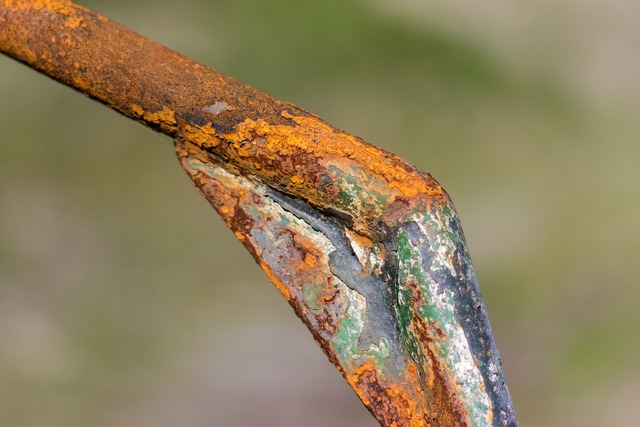
- Very slow — the rusting of iron
- Slow — the spontaneous heating of materials such as oil-soaked rags
- Fast — the burning of paper or wood
- Extremely fast — the exploding of gunpowder upon ignition
Before a fire can occur, three elements must be present:
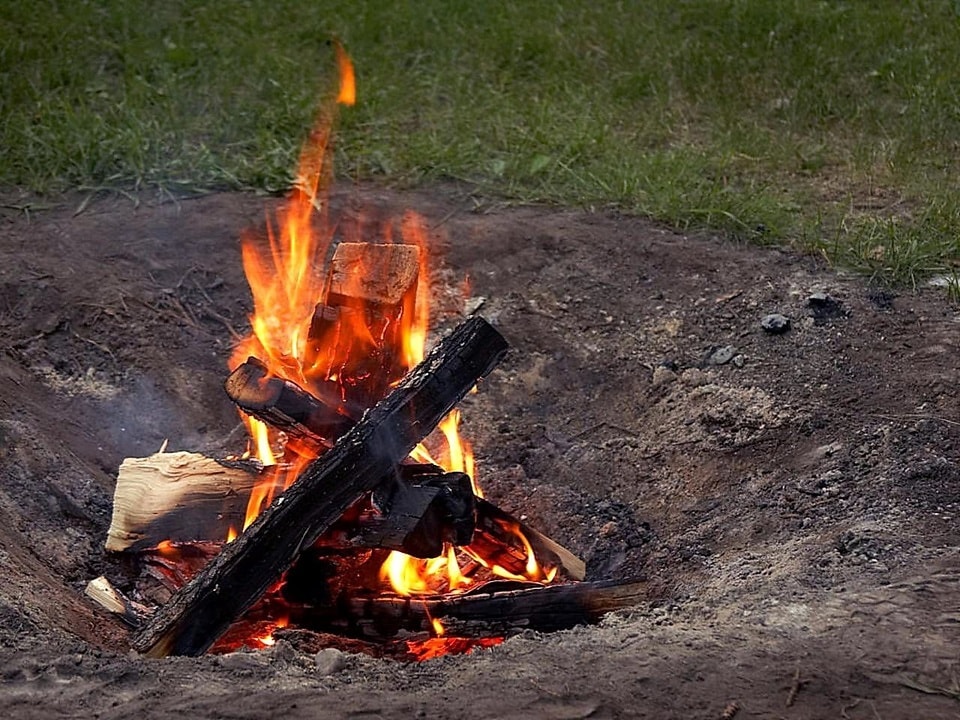
- Fuel
- Oxygen
- Heat (sufficient to raise the fuel to its ignition temperature)
Fuel
Fuel is any combustible material in solid, liquid, or gas form that will combine with oxygen and heat to burn. Combustible material can include common materials such as wood, wood waste products, liquid chemicals, gasoline, paper, or cloth.
Oxygen
Oxygen supports combustion and is always present in the air we breathe at approximately 21 percent concentration. A typical fire requires an atmosphere with only approximately 16 percent oxygen. If pure oxygen were present, some materials that would not normally be considered combustible, including some metals, would burn.
The term oxidizing agent is now often used instead of oxygen, as it helps explain why some materials can burn in an atmosphere free of any other sources of oxygen.
Heat
Heat is anything that will raise the temperature of the fuel to a point where enough gases are given off to burn.
Flashpoint and Autoignition
Flashpoint and autoignition temperature both describe how easily a fuel can ignite, but they refer to different stages of combustion.
The flashpoint is the lowest temperature at which a liquid gives off enough vapour to ignite in the presence of an external ignition source (such as a spark or flame). The autoignition temperature is the lowest temperature at which a substance will spontaneously ignite without any external ignition source. For example, gasoline has a flashpoint of approximately –42.8 °C (–45 °F) and an autoignition temperature of about 246 °C (475 °F).
Fire Triangle
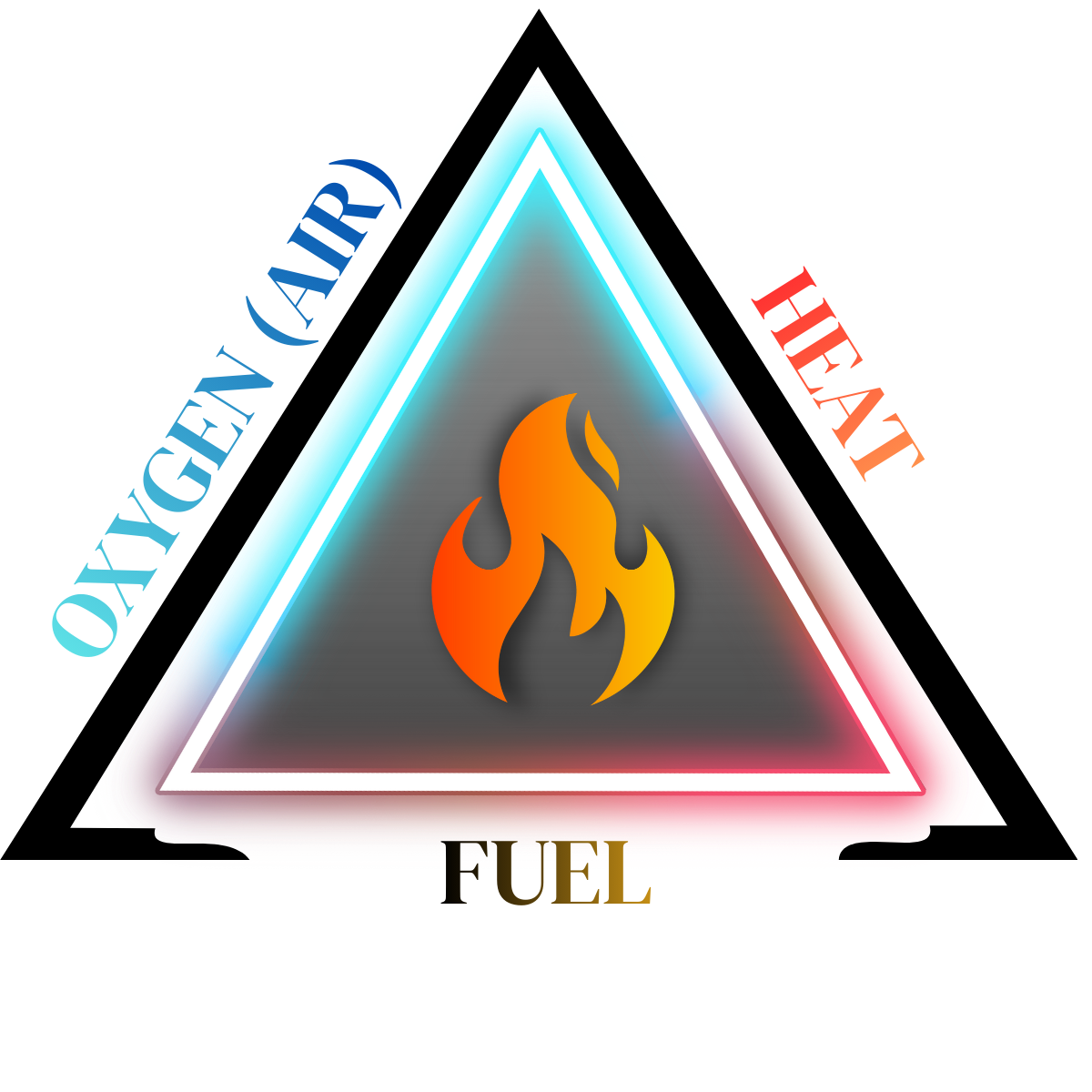
The fire triangle is a simple model for understanding the necessary ingredients for most fires: oxygen, heat, and fuel. When they combine in proper amounts, as shown in the fire triangle diagram (Figure 3), a fire is created. Keeping these three components separated will prevent a fire from occurring. An existing fire can be extinguished by removing any one of the three components.
Fire safety, at its most basic level, is based on the principle of keeping fuel sources and ignition sources separate:
- Remove the fuel (combustible material) from the vicinity of the fire. For example, if you shut off the valve of a gas main, the result will be starvation.
- Remove the heat. For example, by applying water, the result will be cooling.
- Remove the oxygen. For example, if you cover the fire with a lid, a wet blanket, or sand, or use a carbon dioxide, foam, or dry chemical extinguisher, the result is smothering.
Fire Tetrahedron
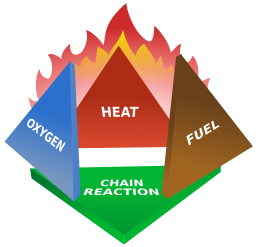
Today there are many newly developed chemicals, resins, materials and metals that burn differently and have varying types of chemical chain reactions that do not fit the traditional theories of the fire triangle. A fourth component of a fire triangle may be a chemical reaction, creating a fire tetrahedron.
The fire tetrahedron represents the addition of a chemical chain reaction to the fire triangle. Once a fire has started, the resulting chain reaction sustains the fire and allows it to continue. Just as removing one of the elements of the fire triangle will extinguish a fire, so will using an extinguishing agent that breaks the chain reaction.
 Self-Test A-5.1: Describe the Conditions Necessary to Support a Fire
Complete Self-Test A-5.1 and check your answers.
If you are using a printed copy, please find Self-Test A-5.1 and Answer Key at the end of this section. If you prefer, you can scan the QR code with your digital device to go directly to the interactive Self-Test.
References
BC Industry Training Authority. (2019). Piping trades apprenticeship program: Perform safety related functions—Level 1 harmonized [Binder]. Crown Publications, Queen’s Printer for British Columbia. https://www.crownpub.bc.ca/Product/Details/7960000260_S
Camosun College. (2015). Line A: Safe work practices — Competency A-5: Describe Fire Safety. BCcampus. https://collection.bccampus.ca/textbook/VPwUd4rq/
Camosun College. (2015). Trades access common core competency A-5: Describe Fire Safety. Victoria, B.C.: Crown Publications. Download for free from the B.C. Open Textbook Collection (https://open.bccampus.ca/browse-ourcollection/find-open-textbooks/).
Media Attributions
All figures are sourced from Industry Training Authority (2019) and/or Camosun College (2019) and are used under the Creative Commons Attribution 4.0 (CC BY 4.0) licence unless otherwise noted. Images copyrighted by the BC Industry Training Authority are licensed under a Creative Commons Attribution-NonCommercial-ShareAlike 4.0 (CC BY-NC-SA 4.0) licence.
- Figure 1 Oxidation by meineresterampe from Pixabay is used under the Pixabay Content License.
- Figure 2 Burning by Jon Sullivan from Pixnio is used under the Pixnio CC0 license.
- Figure 3 Fire triangle (TRU Open Press) has been adapted from Fire triangle by Gustavb on Wikimedia, and is subject to the CC BY-SA 3.0 license.
- Figure 4 Fire tetrahedron (adapted) by Gustavb, via Wikimedia Commons, is in the public domain.
Burning; a chemical reaction that produces heat and often light. (Section A-5.1)
A chemical reaction where a substance combines with oxygen. (Section A-5.1)
A gas in the air that supports burning. (Section A-5.1)
The temperature at which a substance starts to burn. (Section A-5.1)
In fire safety, any material that can burn. (Section A-5.1)
A substance that can catch fire and burn. (Section A-5.1)
A substance that helps something burn by providing oxygen or a similar effect. (Section A-5.1)
The lowest temperature at which a liquid gives off vapour that can ignite with a spark or flame. (Section A-5.1)
The temperature at which a substance ignites on its own without a spark or flame. (Section A-5.1)
A model showing that fuel, oxygen, and heat are needed for a fire to start. (Section A-5.1)
In fire safety, putting out a fire by removing its fuel source so it no longer has anything to burn. (Section A-5.1)
In fire safety, means lowering the temperature of a fire, usually by adding water, so it no longer has enough heat to keep burning. (Section A-5.1)
In fire safety, means putting out a fire by cutting off its oxygen supply, so the fire cannot continue to burn. (Section A-5.1)
A continuing chemical process that keeps a fire burning once it has started. (Section A-5.1)
A model that adds a chemical chain reaction as the fourth part needed to sustain a fire. (Section A-5.1)