A-5.3 Apply Preventive Fire Safety Precautions
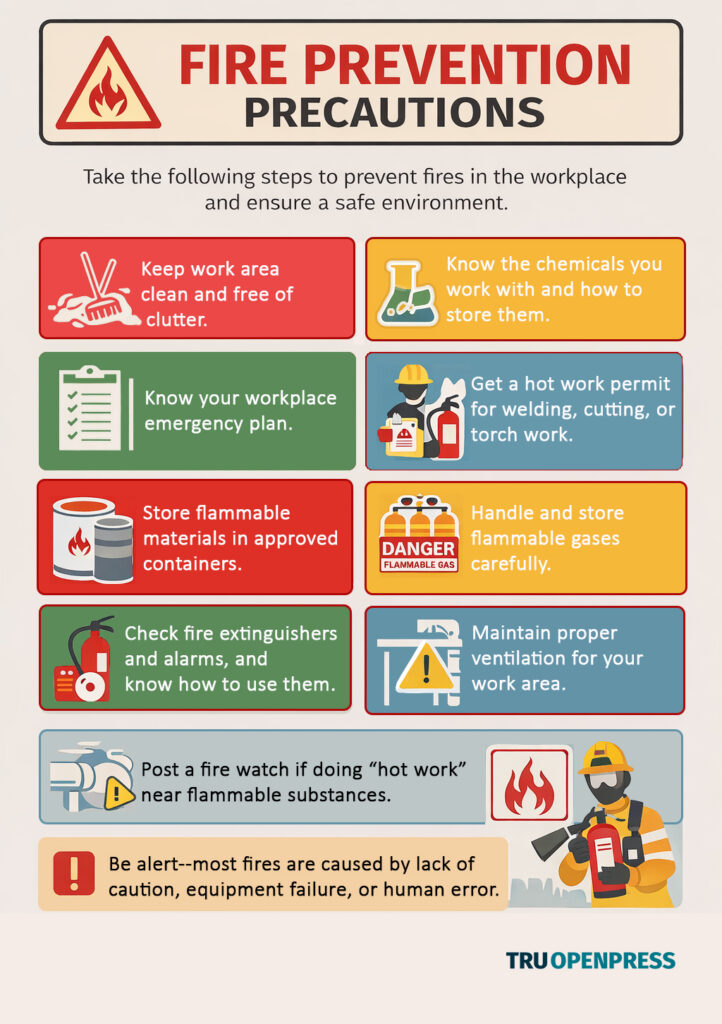
As you already know, fire is only possible where there is a supply of combustible materials, oxygen, and heat. However, lack of caution, equipment failure, or simple human error can cause ignition.
Any fire in the workplace can cause serious injury or property damage. Workers are often required to work in various hazardous environments. Corrosive and explosive substances may be used or stored in these locations. Workers must be aware of the presence of these hazardous substances and take appropriate precautions.
Preparation
Preparation is key to controlling any fires that may start. Take the following precautions to protect your workplace from fire:
- Keep the work area clean and clutter-free.
- Know what chemicals you work with.
- Know how to store and handle the chemicals on your work site.
- Make sure you are familiar with your company’s emergency action plan for fires.
- Know what you are expected to do in a fire emergency.
- Know how to report fires.
- Use caution when using power tools near flammable substances.
Hot Work Permit
Ideally, all welding, cutting, or other torch work would be done in areas free of combustible materials; however, this is not always possible. In those cases, you may be required to get a hot work permit so that all fire hazards in your area can be assessed and the necessary precautions can be listed. Usually, this will involve posting fire watch personnel.
The person on fire watch should have access to fire extinguishers and alarms and know how to use them. The area where the hot work was done must also be monitored afterwards until there is no longer a risk of fire.
Storage of Flammable Materials
The nature of flammable materials makes them vulnerable to ignition. Consequently, storage precautions are necessary. Both WorkSafeBC and the BC Fire Code have regulations regarding maximum quantities of flammable materials that can be stored and how they are stored. The permitted quantities are affected by their flashpoint temperatures.
Flammable Liquids and Related Equipment
The nature of flammable liquids makes them very vulnerable to ignition, and the following storage precautions are therefore necessary:
- All containers of flammable liquids must be of an approved type (CSA or ULC in Canada) and clearly marked.
- All containers must have secure capping devices.
- Open flames or lit cigarettes must be prohibited within or near any liquid-gas storage area.
- Where drums are used as containers, they must have taps and a drip tray.
- Transportation must only take place while containers are sealed.
- All empty containers must be stored upright.
- Spills must be cleaned up or covered with sand.
Any equipment that requires a flammable liquid needs the same basic precautionary measures as stored liquids. All tank or equipment leaks must be reported and then repaired immediately.
Drivers and operators must be warned of ignition hazards while refuelling such equipment. They must not smoke, and the engines must be stopped.
Flammable Gases
Flammable gases used on work sites often include acetylene, hydrogen, ethane, and propane. These gases are hydrocarbons. Natural gas, acetylene, ethane, and propane are compounds, while diesel and gasoline are mixtures made up of mostly hydrocarbon compounds. Some of these gases are stored in pressurized cylinders, which must be handled with care.
Read OHS Regulation Part 5: Chemical Agents and Biological Agents from the WorkSafeBC website.
Aerosol products can contain flammable gases and present a fire hazard. You should be familiar with how to handle and dispose of such products safely.
Ventilation
Flammable gases or vapours may accumulate in a room as part of the workplace process. It is important to properly ventilate the space to reduce the risk of fire and health hazards.
Do not cut or weld any container that you suspect may have contained a combustible substance. Even a gasoline tank that contains no liquid gasoline can have enough vapours present to cause an explosion. You must have the container thoroughly purged and inspected.
Combustible Materials
Rubbish is a severe problem in fire prevention, but it can always be avoided through good management. Any buildup of packing materials, sawdust, wood shavings, oil waste, or other combustible material constitutes a potential fire hazard. The following precautions must always be taken:
- All waste liquids that are flammable must be placed in approved containers for disposal according to waste disposal regulations.
- Open fires require a permit, and they must be constantly supervised.
- Extinguishers must be available at or near any fire lit for the disposal of rubbish.
- All oily rags must be retained in metal bins with sealed lids.
- Don’t allow fine dust to build up, as it can be highly flammable and often explosive.
Shop Electrical Wiring and Equipment
All wiring, whether permanent or temporary, must be made safe so that it does not cause a fire. The following precautions are necessary:
- Any temporary or permanent wiring at ground level must be buried or protected from foot or vehicular traffic damage by use of ramps.
- All portable electric-powered hand tools must be connected with flexible rubber or sheathed PVC cables.
- Adequate breaker protection against excess current must be included.
A static grounding system must be used on fuel storage equipment to ensure there isn’t a buildup of static electricity that could arc spark to ground and cause an explosion.
Vehicle Electrical Systems
You should observe extreme caution when servicing electrical systems. Serious fires could result from short circuits in the wiring. Batteries being charged or exposed to heavy discharge (such as during a cold or no-start situation) give off explosive gases (hydrogen), which can ignite if a spark is present.
When removing batteries, always disconnect the ground wire first. All wiring leading to the starter motor and switch must be protected from sharp edges and mechanical or heat damage. If installing a new cable, always route it to avoid damage.
Safe Use of Temporary Heating
Temporary heating is often required on the job site. This heating may be powered by electricity or fuelled by propane, kerosene, or diesel. These heaters are usually non-ducted and are therefore considered space heaters — although they are commonly known as construction heaters. It is important to follow the manufacturer’s instructions and take extra precautions against burns and fire when using these heaters.
 Self-Test A-5.3: Apply Preventive Fire Safety Precautions
Complete Self-Test A-5.3 and check your answers.
If you are using a printed copy, please find Self-Test A-5.3 and Answer Key at the end of this section. If you prefer, you can scan the QR code with your digital device to go directly to the interactive Self-Test.
References
BC Industry Training Authority. (2019). Piping trades apprenticeship program: Perform safety related functions—Level 1 harmonized [Binder]. Crown Publications, Queen’s Printer for British Columbia. https://www.crownpub.bc.ca/Product/Details/7960000260_S
Camosun College. (2015). Line A: Safe work practices — Competency A-5: Describe Fire Safety. BCcampus. https://collection.bccampus.ca/textbook/VPwUd4rq/
Camosun College. (2015). Trades access common core competency A-5: Describe Fire Safety. Victoria, B.C.: Crown Publications. Download for free from the B.C. Open Textbook Collection (https://open.bccampus.ca/browse-ourcollection/find-open-textbooks/).
Province of British Columbia. (2025, June 9). BC Fire Code. Government of British Columbia. https://www2.gov.bc.ca/gov/content/industry/construction-industry/building-codes-standards/bc-codes/fire
WorkSafeBC. (n.d.). OHS regulation: Part 5 — Chemical and biological substances. Government of British Columbia. https://www.worksafebc.com/en/law-policy/occupational-health-safety/searchable-ohs-regulation/ohs-regulation/part-05-chemical-and-biological-substances
Media Attributions
All figures are sourced from Industry Training Authority (2019) and/or Camosun College (2019) and are used under the Creative Commons Attribution 4.0 (CC BY 4.0) licence unless otherwise noted. Images copyrighted by the BC Industry Training Authority are licensed under a Creative Commons Attribution-NonCommercial-ShareAlike 4.0 (CC BY-NC-SA 4.0) licence.
- Figure 1 Fire Prevention Infographic was created by TRU Open Press with help from ChatGPT (OpenAI), 2026. Licensed under CC BY-NC-SA 4.0.
A written safety approval required before doing work that creates heat or sparks. (Section A-5.3)
A trained person who watches for fires during and after hot work. (Section A-5.3)
Chemical substances made of hydrogen and carbon that can burn, such as gasoline. (Section A-5.3)
Strong containers that hold gases under high pressure. (Section A-5.3)
Moving fresh air into a work area to remove harmful fumes, gases, or dust. (Section A-1.4)
Cleaned out to remove gases or dangerous substances. (Section A-5.3)
A safety system that removes built-up electricity to prevent sparks. (Section A-5.3)
An electrical problem where electricity flows the wrong way and can cause sparks or fire. (Section A-5.3)
A portable heater used to warm a room or work area. (Section A-5.3)
A portable heater used at building sites to keep the air warm while workers are constructing or repairing a building. It helps dry materials like paint or concrete and keeps workers safe and comfortable in cold weather. Construction heaters can run on electricity, propane, natural gas, or diesel fuel. (Section A-5.3)