A-4.3 Lift and Move Objects Safely
In the piping trades, moving tools, pipe, and equipment is part of everyday work. Knowing how to lift and carry objects safely helps prevent injuries and ensures you can work efficiently over the long term. This section explains how to protect your back and body through proper lifting techniques and ergonomic awareness.
Preventing lower back injury on the job is particularly important. You can keep your back healthy by paying attention to ergonomics (the relationship between you and your work environment) and the rules for safe lifting and carrying.
The design of the human body is such that the back is especially susceptible to injury if it is not treated with respect. Know your own strengths and limitations. A high percentage of all workplace injuries involve the back. Basic precautions and lifting techniques are easy to learn and apply and can greatly reduce the chances of serious back injury.
General Rules for Lifting and Moving Objects
Always follow these rules, even for lifting light objects:
- Place your feet apart for good balance.
- Bend your knees.
- Hold the object as close to your body as possible.
- Lift smoothly and slowly.
- Pivot with your feet; don’t twist your back.
- Push, rather than pull, the load.
- Share the load; work with a partner.
- Get mechanical assistance for heavy loads.
Many of the objects you may have to lift and move can be heavy and awkward, including beams, planks, plywood, panel products, ladders, and wheelbarrows. The following safe lifting procedures are recommended for most tasks.
| Body Position | Recommended Safe Lifting Practice | Why It Matters |
|---|---|---|
| Feet | Stand with your feet spaced apart, with one foot slightly in front of the other. | Provides stability and balance when lifting heavy or awkward objects. |
| Back | Keep your back straight; do not bend, arch, or twist. | Reduces the risk of back strain or serious injury. |
| Chin | Keep your chin tucked toward your chest. | Helps keep your back straight and properly aligned. |
| Palms (Grip) | Use a full palm grip with fingers close together. | The palm is stronger than the fingers alone, allowing for safer lifting. |
| Body Weight | Keep your balance and distribute your weight evenly on both feet. | Improves control and reduces strain during the lift. |
| Arms | Keep your arms tucked close to your sides. | Allows you to carry more weight safely and reduces injury risk. |
Procedures for Lifting Specific Objects
Before moving anything, make sure your path is clear of obstacles and that there is space to put the object or material down. Depending on how you have to move the object, your vision may be blocked on one side. Be sure you can see where you’re going.

Plywood
To pick up and carry a sheet of plywood, wear leather gloves and use this procedure:
- Stand the plywood on its narrow edge in a vertical position. If the plywood is lying flat on the ground, go to one end and pick up the narrow edge. Then lift and walk toward the plywood until it is standing vertically on its narrow edge. This method requires you to lift only half the weight of the plywood from the ground.
- Place your hands at the midpoints of the long edges of the plywood. Roll the sheet onto your right or left hand. The sheet should be balanced in the carrying hand. This avoids straining your back when trying to keep the sheet from dropping at one end.
- If your grip feels uncomfortable, put the sheet down on its narrow edge and take a new grip. If you lean the sheet of plywood into your shoulder, some of the weight will transfer from your hand. Figure 1 shows the correct way to hold and carry a large, lightweight panel product.
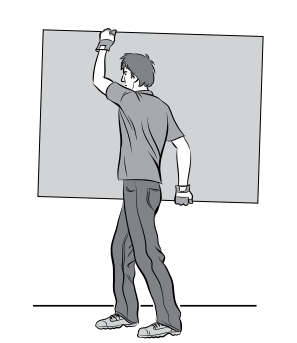
Always ask for help if you need it. For example, if there are obstacles to move around, get someone to help you carry the sheet. In this situation, there should be one person at each end. If it is windy, you may have difficulty carrying large sheets, so again, ask for help.
Planks and Beams
If they are not too heavy, planks and beams can be carried on your hip or shoulder. If the plank or beam is too heavy, get help or use mechanical assistance such as a hoist or forklift. The plank or beam should be off the floor on blocking so that you can easily get your hands under it. To place blocking under the plank or beam, you may have to turn it on its edge or use a crowbar to lift it up.
The following is the procedure for carrying a beam:
- Bend down, keeping your back straight and your feet slightly apart, pointed in the direction that you want to move.
- Place one hand on each side of the beam near the middle, one hand slightly forward and the other slightly behind.
- Lift slightly to check the weight and the balance, then relocate your hands until you have the proper balance.
- Stand up slowly, keeping your back straight and using your leg muscles.
- Hold the plank or beam close to your body and let your hip carry some of the weight.
If you want to carry the plank or beam on your shoulder, pick it up from one end and walk and lift it toward the other end until it is on your shoulder. With the beam on your shoulder, adjust the balance so that slightly more of the weight is behind than in front. This way you can pull the plank or beam down in front of you to keep your balance.
Before you move a plank or beam, make sure that the way is clear and that there is a space to place it. Both planks and beams should be put down on blocking if they are not put directly into place in the building structure.
Do not twist your back when moving heavy weights. Use your feet to change direction of travel. Do not carry any more than you can comfortably handle and control at all times. If you are forced to drop your load or if you lose control of it, you risk injuring yourself or a co-worker.
Steel Pipe and Rebar
Steel pipe can be carried in the same manner as the beams or planks. If there is more than one pipe to carry at the same time, bundle and tie them together at each end and in the middle. If you try to carry more than one pipe at a time, you can easily lose control of them as they will want to go in different directions.
Ladders
Extension ladders come in various lengths, and the longer the ladder, the heavier it is. Most trades workers should be able to handle a 5 m (16 ft.) ladder by themselves. Longer ladders should be handled by two people.
A ladder is usually carried on the shoulder, with one arm placed between the rails and the other hand used to balance it. The ladder should be picked up in the same manner as beams or planks.
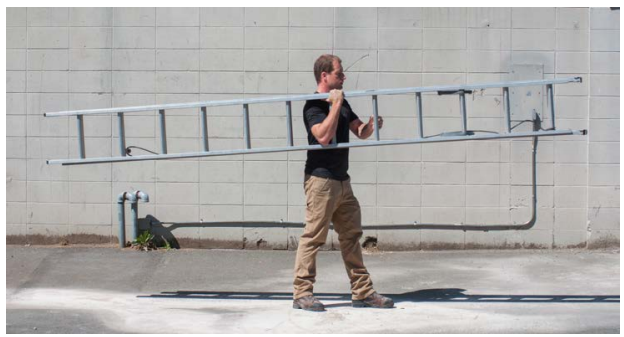
Do not drop a ladder or let it hit anything. You could crack the side rails and make the ladder unsafe.
Wheelbarrows
One worker can carry a very heavy load (up to 300 kg) in a wheelbarrow. Before using a wheelbarrow, check that the wheel is properly inflated and centred on its axle.
When you use a wheelbarrow, always maintain your balance. Keep the bulk of the weight in a wheelbarrow toward its front for greater control, and make sure it’s not overfilled. When turning a corner, tilt the barrow slightly in the direction of the turn, just as you would tilt a bicycle — not too sharply, or you may tip the load. When you go downhill, hold back the barrow to prevent losing control.
In the construction industry, wheelbarrows are primarily used to place concrete and gravel. They have a narrow spout to direct the concrete into the forms, and there is an extension of the handrails past the front wheel. This allows the barrow to be tipped and the contents dumped. Be sure to protect any surfaces that may break or chip from coming into direct contact with the handrail extensions when pouring.
When you move a wheelbarrow, use the following technique:
- Bend your knees, keeping your back straight, your chin in, and your feet slightly apart.
- Lift in a smooth motion and push the barrow in the direction you want to go, tilting the barrow to make the turns.
- When you take a wheelbarrow up a ramp and you need help to move the barrow, only one person should do the pushing. The other should use a long hook on the front of the barrow and pull it up the ramp. If two people try to push the barrow, balance will be lost and the contents will spill.
Shovelling
Shovelling may seem like a simple task, but if done incorrectly, it can cause injury. There are basic rules for using a shovel comfortably and safely:
- Keep your back as straight as possible.
- Bend at the hips and keep your feet slightly apart, with one ahead of the other.
- Place yourself in a comfortable position and have a cleared area to work in. You will find that a long-handled shovel is easiest to work with. Not only will it provide more leverage, but it will not require you to bend very far.
- If you are right-handed, your left hand should grip the shovel just above the metal ferrule, and the right hand should be nearer the top of the shovel handle.
- Slide or push the shovel into the material.
- Drop the end of the shovel slightly to catch the material. Then draw the shovel toward you, allowing it to slide on the ground.
- When the shovel is near you, you can then lift with your left hand and steady your right hand to move the material by tossing it off to the side or behind you.
You can also use your knee for leverage to help lift up a shovel. The motion of using the shovel should feel comfortable, without any strain. If the load on the shovel is too heavy, take smaller loads.
Learn to pace yourself. If you start too vigorously, you will quickly tire and be unable to maintain a steady pace.
The best shovelling method depends on the material to be moved. Drain rock or gravel should be picked up from the bottom edge of the pile, rather than from the middle or top. Sand can be picked up from any part of the pile.
Soil that has been dumped by truck can be taken near the bottom of the pile. Soil that has to be dug out of the ground may have to be loosened with a pick or maddock before it can be easily picked up.
Barrels and Drums
Large barrels or drums are moved by rolling them on their rims. If a barrel is lying on its side, it must be placed in the upright position by using the following procedure:
- Stand at the top end of the barrel and bend your legs (but keep your back straight) so that you can get a good grip on each side of the rim near the bottom.
- Lift the barrel toward the upright position and, as it reaches the balance point, be ready to change your grip so that you can prevent the barrel from dropping on its end.
If the barrel is full, you will need the help of a second person or the use of a barrel dolly, which is designed to pick up and move barrels.
Small Pails
Small pails (20 to 25 L, or 5 to 6 gal.) used for paints, adhesives, coatings, and the like are quite heavy, so you need to be careful when moving them.
Check that the handles are properly secured, inserted into the holders at the sides of the containers. If the handle slips, the container could fall and injure your foot.
To pick up a heavy container, bend your legs, keeping your back straight. Reach down and grip the handle and then stand erect and carry the container to the desired location. To keep your balance, you may find it easier to carry two pails at the same time.
Containers to be moved up to a scaffold platform should be raised with a rope-and-pulley system. They are usually too heavy to be pulled up by a rope only.
Boxes
Many items come in heavy boxes or sacks. To pick up boxes from the floor or ground safely:
- Bend your legs, keeping your back straight and your feet apart, one foot slightly ahead and the other slightly behind.
- Move close to the box. Place your left hand on the top left corner away from you and place your right hand on the lower right corner next to you.
- Tilt the box away from you, keeping the weight of the box on the floor. Then tilt the box to judge its weight.
- Using the palm grip, grasp the bottom edges of the box (Figure 4) and use your leg muscles to stand up. Turn your feet in the direction you want to move.
- When carrying a heavy object, do not twist your back to change direction.
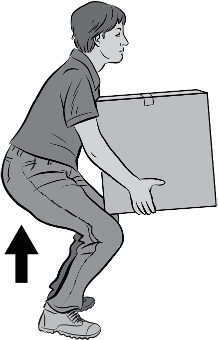
The instructions for lowering the box are the reverse of the directions for lifting. If the box is too heavy, get someone to help you. If it is too heavy for two people to lift, use mechanical equipment such as a forklift.
Back Maintenance
Strong, flexible muscles are essential for a healthy back. They support the spinal column and determine posture, which is key to preventing injury. If your muscles are weak or tight, back injuries are more likely and recovery is more difficult.
Exercise and Your Back
Stay fit by exercising regularly to maintain flexibility, strength, and endurance. If you are receiving professional back care, do only those exercises you have been instructed to perform.
Stretching
Athletes warm up and do stretching exercises before practices and events to limber up the joints and get blood flowing to muscles. The same principles apply to lifting. By stretching and warming up, along with taking basic precautions and following proper lifting techniques, you can greatly reduce your chances of serious injury.

Go to the WorkSafeBC (2014) website to review Back Talk: An Owner’s Manual for Backs and additional information on back care and maintenance.
 Self-Test A-4.3: Lift and Move Objects Safely
Complete Self-Test A-4.3 and check your answers.
If you are using a printed copy, please find Self-Test A-4.3 and Answer Key at the end of this section. If you prefer, you can scan the QR code with your digital device to go directly to the interactive Self-Test.
References
BC Industry Training Authority. (2019). Piping trades apprenticeship program: Perform safety related functions—Level 1 harmonized [Binder]. Crown Publications, Queen’s Printer for British Columbia. https://www.crownpub.bc.ca/Product/Details/7960000260_S
Camosun College. (2015). Line A: Safe work practices — Competency A-4: Describe personal safety practices (BCcampus). https://collection.bccampus.ca/textbook/xQpDrgQM/
Camosun College. (2015). Trades access common core competency A-4: Describe personal safety practices. Victoria, B.C.: Crown Publications. Download for free from the B.C. Open Textbook Collection (https://open.bccampus.ca/browse-ourcollection/find-open-textbooks/). https://pressbooks.bccampus.ca/tradesaccesscommoncorelineaa4/chapter/personal-protection/
WorkSafeBC. (2014, December). Back talk: An owner’s manual for backs. https://www.worksafebc.com/en/resources/health-safety/books-guides/back-talk-an-owners-manual-for-backs
Media Attributions
All figures are sourced from Industry Training Authority (2019) and/or Camosun College (2019) and are used under the Creative Commons Attribution 4.0 (CC BY 4.0) licence unless otherwise noted. Images copyrighted by the BC Industry Training Authority are licensed under a Creative Commons Attribution-NonCommercial-ShareAlike 4.0 (CC BY-NC-SA 4.0) licence.
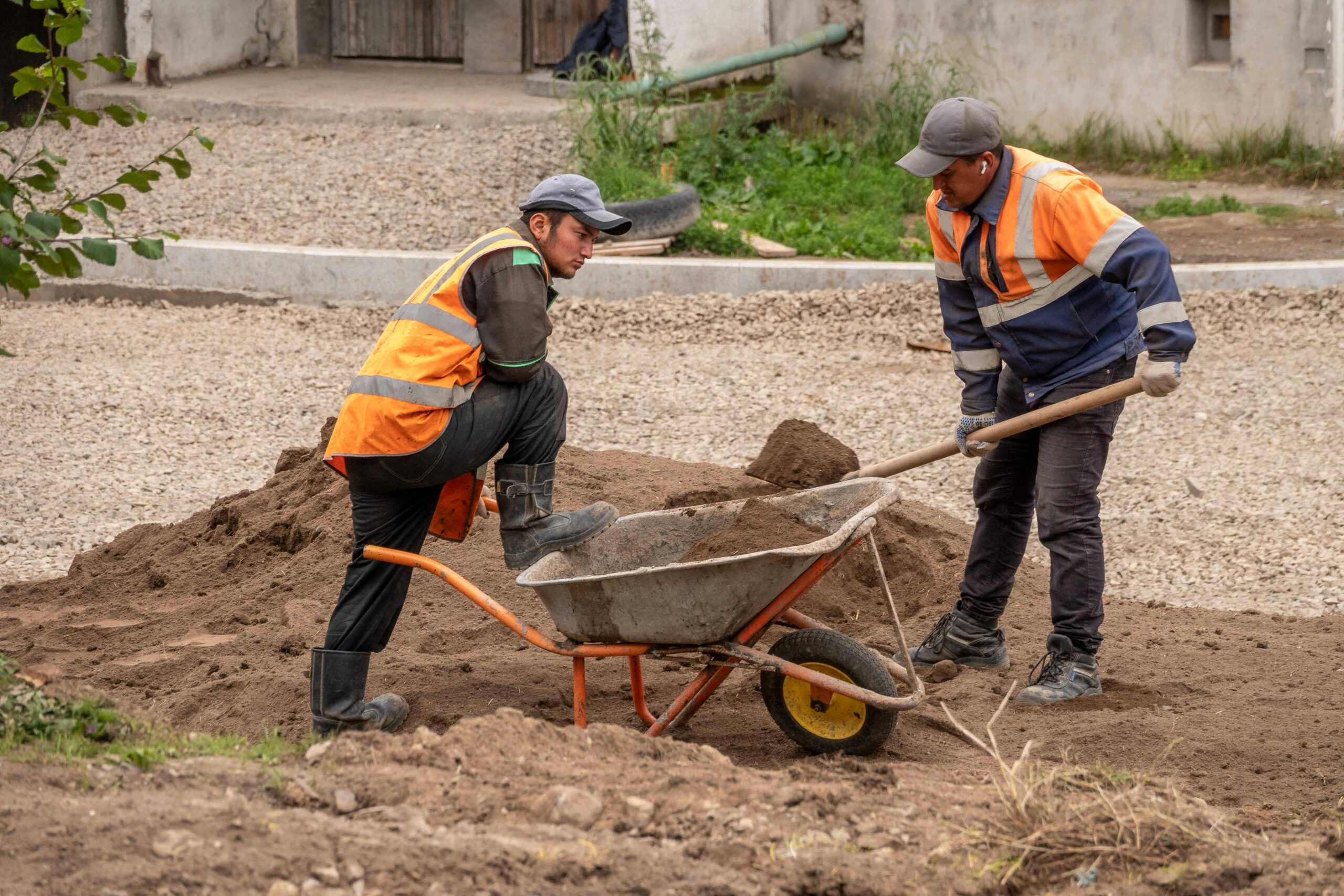
- Figure 3 Wheelbarrow by Sergei Starostin from Pexels is used under the Pexels License
How your body fits and works with your tools and workspace. (Section A-4.3)
To turn your whole body using your feet instead of twisting your back. (Section A-4.3)
Machines or equipment used to help lift or move heavy objects. (Section A-4.3)
A device used to lift heavy objects using a rope or chain. (Section A-4.3)
A powered machine used to lift and move heavy loads. (Section A-4.3)
Wood or material placed under an object to lift it off the ground. (Section A-4.3)
A rod that holds a wheel in place and allows it to turn. (Section A-4.3)
A temporary platform used to work at heights. (Section A-4.3)
A lifting system that uses a rope and wheel to raise heavy items. (Section A-4.3)
The backbone that supports your body and protects your spinal cord. (Section A-4.3)
The way you hold your body when standing, sitting, or lifting. (Section A-4.3)