A-3.5 Identify Pictograms Found on WHMIS Labels
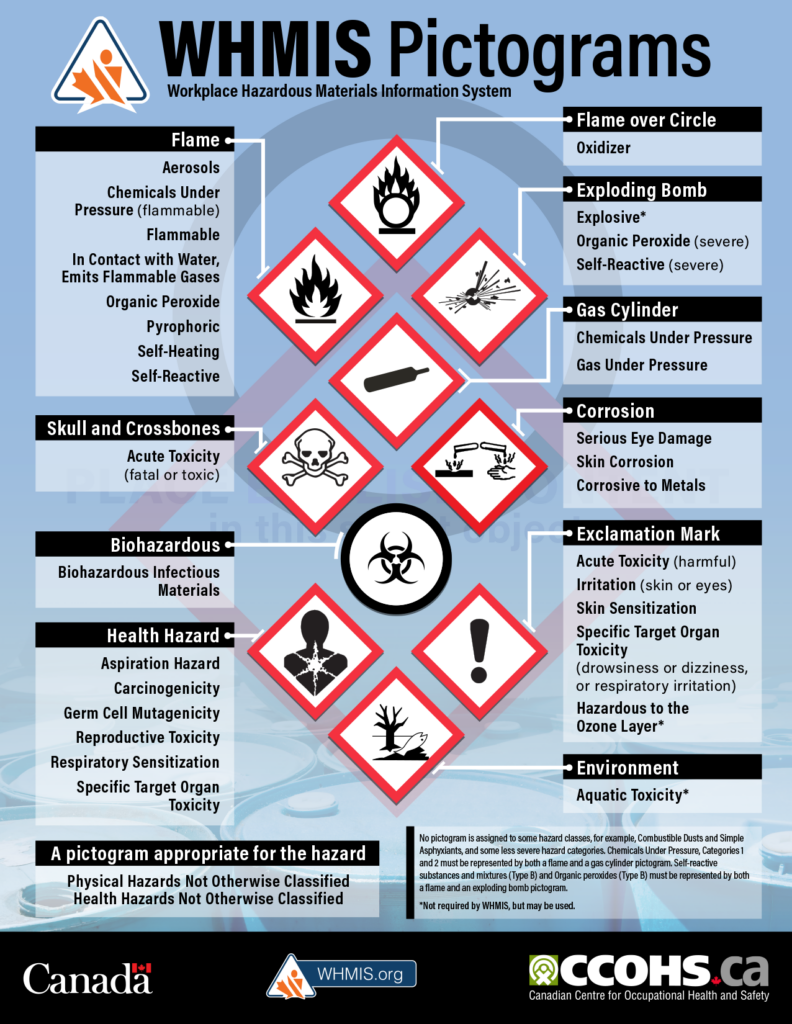
Pictograms are graphic images that immediately show you what type of hazard a hazardous product presents.
Manufacturers and suppliers classify the products into one or more of the hazard classes and assign one or more of the appropriate pictograms. Pictograms will be on the product supplier labels of the hazardous products as well as on the SDSs.
Workers must recognize the ten hazard pictograms and know what they mean. Most pictograms have a distinctive red border in the shape of a square set on one of its corners. Inside this border is a symbol that represents the potential hazard (e.g., fire hazard, health hazard, corrosive, etc.). With a quick glance, a worker can see, for example, that the product is flammable or if it might be a health hazard.
Hazard Classes, Categories and Pictograms
Table 1 shows each hazard pictogram, its name, hazard description, and the associated hazard classes and categories.
| Name/Description | Pictogram | Classes and categories |
| Flame
(for fire hazards) |
 |
|
| Flame over circle
(for oxidizing hazards) |
 |
|
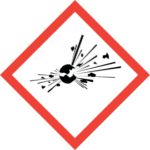
| Exploding bomb
(for explosion or reactivity hazards) |
 |
|
| Corrosion
(for corrosive damage to metals, as well as skin, eyes) |
 |
|
| Gas cylinder
(for gases under pressure) |
 |
|
| Skull and crossbones
(can cause death or toxicity with short exposure to small amounts) |
 |
|
| Exclamation mark
(may cause less serious health effects or damage the ozone layer) |
 |
|
| Health hazard
(may cause or suspected of causing serious health effects) |
 |
|
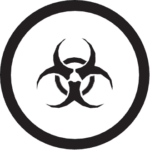
| Biohazardous infectious materials
(for organisms or toxins that can cause diseases in people or animals) |
 |
|
Note: *Both the flame and explosive pictograms are used for self-reactive substances and mixtures (Type B) and organic peroxides (Type B).
An environmental hazards group exists in the GHS for products that may cause damage to the aquatic environment. This group (and its classes) were not adopted in WHMIS 2015. However, you may see the environmental pictogram (Figure 1) listed on labels and SDSs.

Hazard Classes and Categories Without Pictograms
There are hazardous products that meet the criteria for a hazard class or category but whose classes and categories do not require a pictogram. The product label and Section 2 (Hazards Identification) of the SDS still require the signal word, hazard statement(s), and other required label elements.
WHMIS 2015 classes and categories that do not require a pictogram are:
- Flammable gases—Category 2
- Flammable liquids—Category 4
- Self-reactive substances and mixtures—Type G
- Organic peroxides—Type G
- Combustible dusts—Category 1
- Simple asphyxiants—Category 1
- Serious eye damage/eye irritation—Eye irritation—Category 2B
- Reproductive toxicity—Effects on or via lactation
 Self-Test A-3.5: Identify Pictograms Found on WHMIS Labels
Complete Self-Test A-3.5 and check your answers.
If you are using a printed copy, please find Self-Test A-3.5 and Answer Key at the end of this section. If you prefer, you can scan the QR code with your digital device to go directly to the interactive Self-Test.
References
BC Industry Training Authority. (2019). Piping trades apprenticeship program: Perform safety related functions—Level 1 harmonized [Binder]. Crown Publications, Queen’s Printer for British Columbia. https://www.crownpub.bc.ca/Product/Details/7960000260_S
Camosun College. (2015). Line A: Safe Work Practices — Competency A-3: Handle Hazardous Materials Safely (BCcampus). https://collection.bccampus.ca/textbook/PMfB6kHM/
Camosun College. (2015). Trades Access Common Core Competency A-3: Handle Hazardous Materials Safely. Victoria, B.C.: Crown Publications. Download for free from the B.C. Open Textbook Collection (https://open.bccampus.ca/browse-ourcollection/find-open-textbooks/).
Canadian Centre for Occupational Health and Safety (CCOHS). (2024). WHMIS pictograms. Free, downloadable WHMIS pictograms as regulated by the Hazardous Products Regulations. Retrieved from https://www.ccohs.ca/WHMISpictograms.html
Media Attributions
All figures are sourced from Industry Training Authority (2019) and/or Camosun College (2019) and are used under the Creative Commons Attribution 4.0 (CC BY 4.0) licence unless otherwise noted. Images copyrighted by the BC Industry Training Authority are licensed under a Creative Commons Attribution-NonCommercial-ShareAlike 4.0 (CC BY-NC-SA 4.0) licence.
- WHMIS pictograms, pictogram poster and WHMIS labels posters downloaded from the CCOHS (2024) WHMIS Pictograms Kit (downloads) page are used with permission and under the CCOHS terms for educational purposes.
Something that can burn, eat away, or damage materials like skin, eyes, or metal. Corrosive substances can cause serious injuries if they touch your body, so they must be handled very carefully. (Section A-3.5)