A-2.3 State the Responsibilities of Employers, Workers and Others at the Workplace
A safe workplace is one that has a variety of people working together to ensure proper workplace safety is followed. Each person has a certain responsibility, and if each does her or his part, a safe workplace should result. The Workers Compensation Act (WCA) identifies the responsibilities of three main groups, as shown in Figure 1. In some cases, an individual may have responsibilities in more than one group.
- Employer
- Worker
- Other:
- Owner
- Supervisor
- Supplier
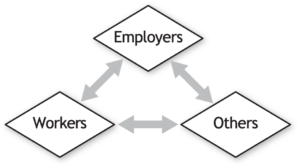
Division 4 — General Duties of Employers, Workers and Others in Part 2 — Occupational Health and Safety of the WCA identify the general duties of employers, workers and others in the workplace.
Employers’ Workplace Responsibilities
The WCA identifies responsibilities that are common to all places of employment. To ensure health and safety, the employer must:
- Remedy workplace hazardous conditions
- Ensure that workers:
- Are aware of known or foreseeable hazards of their work
- Comply with the Act and Regulation
- Are made aware of their rights and duties
- Establish occupational health and safety policies
- Provide and maintain protective equipment, devices, and clothing as required
- Provide information, instruction, training, and supervision to workers carrying out their work
- Make a copy of the Act and Regulation available for review by workers
- Co-operate with workplace safety representatives and WorkSafeBC
Workers’ Workplace Responsibilities
According to the WCA, the worker is responsible for his or her own safety on the job as well as the safety of others. The Act states that every worker must:
- Carry out work in accordance with established safe work procedures
- Use and wear protective equipment, devices and clothing as required
- Not engage in horseplay or similar conduct that endangers the worker or others
- Ensure that the worker’s ability to work is not impaired by alcohol, drugs, or other causes
- Report to the supervisor or employer:
- Issues contravening the Act or Regulation
- Defects in or absence of protective equipment, devices and clothing
- Existence of any hazards that the worker considers potentially dangerous
- Co-operate with workplace safety representatives and WorkSafeBC
Others’ Workplace Responsibilities
Supervisors’ Workplace Responsibilities
To ensure the health and safety of the workers under their direct supervision, a supervisor must:
- Be knowledgeable about the Act and any regulations that apply to their workplace
- Ensure workers are made aware of all known or reasonably foreseeable health or safety hazards in the area where they work
- Consult and co-operate with workplace safety representatives and WorkSafeBC
Owners’ Workplace Responsibilities
Every owner of a workplace must:
- Provide and maintain the owner’s land and premises that are being used as a workplace in a manner that ensures the health and safety of persons at or near the workplace
- Give to the employer or prime contractor at the workplace the information known to the owner that is necessary to identify and eliminate or control hazards to the health or safety of persons at the workplace
Suppliers’ Workplace Responsibilities
Every supplier must:
- Ensure that any tool, equipment, machine or device or any biological, chemical or physical agent that they supply is safe when used according to the directions provided by the supplier
- Ensure that any biological, chemical or physical agent that they supply is labelled according to the applicable federal and provincial legislation
- Maintain any tool, equipment, machine or device in safe condition if the supplier has responsibility under a leasing agreement to maintain it
 Self-Test A-2.3: State the Responsibilities of Employers, Workers and Others at the Workplace
Complete Self-Test A-2.3 and check your answers.
If you are using a printed copy, please find Self-Test A-2.3 and Answer Key at the end of this section. If you prefer, you can scan the QR code with your digital device to go directly to the interactive Self-Test.
References
BC Industry Training Authority. (2019). Piping trades apprenticeship program: Perform safety related functions—Level 1 harmonized [Binder]. Crown Publications, Queen’s Printer for British Columbia. https://www.crownpub.bc.ca/Product/Details/7960000260_S
Camosun College. (2015). Line A: Safe Work Practices — Competency A-2: Describe WorkSafeBC regulations (BCcampus). https://collection.bccampus.ca/textbook/4x48JUbq/
Camosun College. (2015). Trades Access Common Core Competency A-2: Describe WorkSafeBC regulations. Victoria, B.C.: Crown Publications. Download for free from the B.C. Open Textbook Collection (https://open.bccampus.ca/browse-ourcollection/find-open-textbooks/).
Government of British Columbia. (n.d.). Workers Compensation Act: Part 2 — Occupational health and safety. In Workers Compensation Act (RSBC 2019, c. 1). https://www.bclaws.gov.bc.ca/civix/document/id/complete/statreg/19001_02
WorkSafeBC. (n.d.). Workers Compensation Act Part 2: Occupational health and safety. https://www.worksafebc.com/en/law-policy/occupational-health-safety/searchable-ohs-regulation/workers-compensation-act/part-2-occupational-health-and-safety
Problems at work where the rules for health and safety are not being followed. For example, if safety gear is missing, training was not provided, or unsafe work is allowed. (Section A-2.3)